
The Salt Storage Building That Protects Your Budget

Salt and sand storage operations have a short list of non-negotiable requirements. First, trucks need to dump fast. Next, loaders need to move freely. Then, material needs to stay dry. Finally, the building needs to hold up in one of the most corrosive environments a structure can occupy.
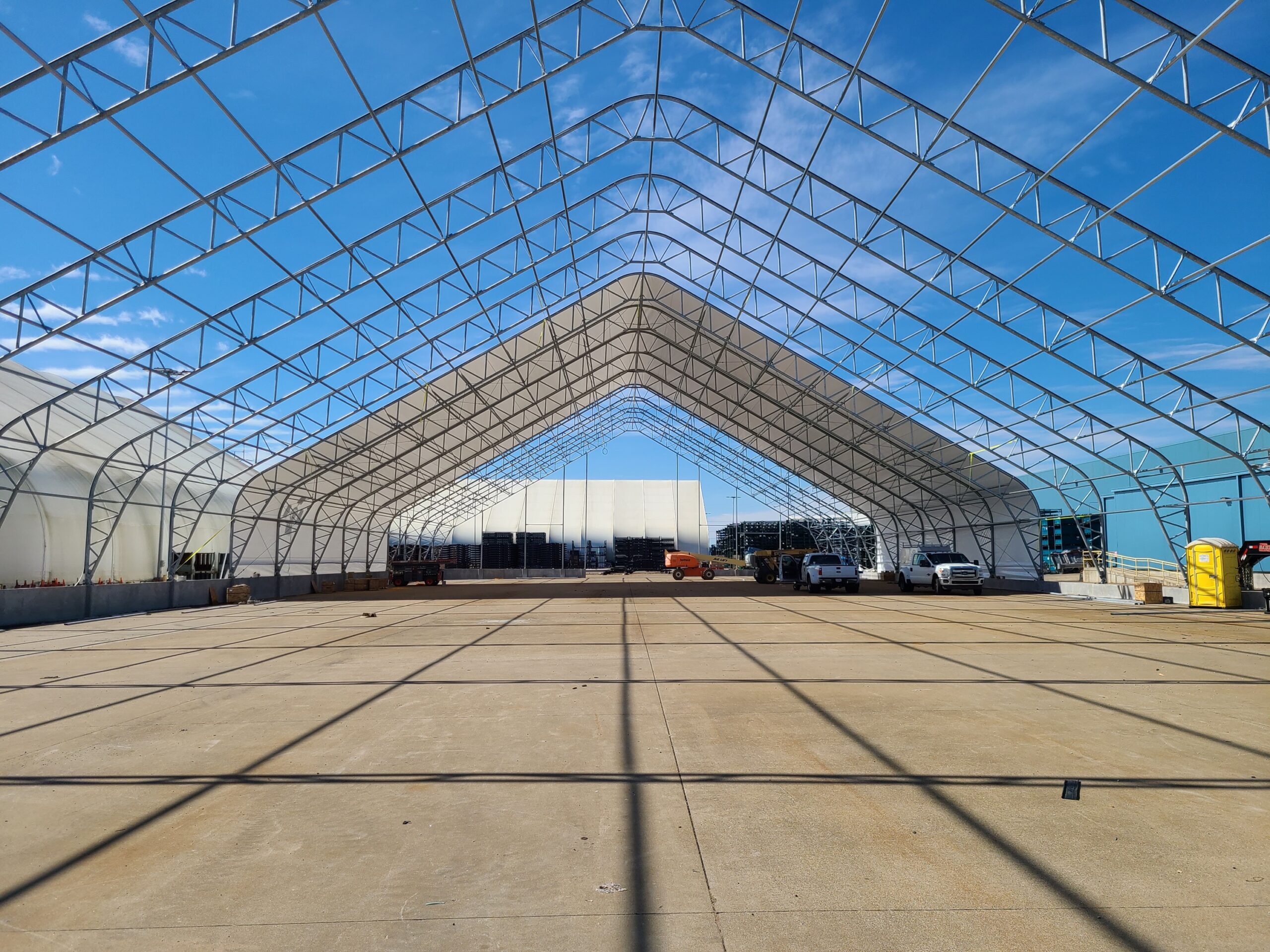
The Magnum Series fabric building was built specifically for those demands. Britespan developed it after interviewing 100 salt storage facility owners. Those conversations shaped what an ideal structure for the industry should look like. The result is a building engineered specifically for salt storage. It combines tall vertical clearances, independent truss mounting, hot-dip galvanized steel, and a foundation approach that reduces total project cost without compromising structural integrity.
What Makes the Magnum Series Different From Other Clear Span Fabric Buildings
Most clear span fabric buildings are general-purpose structures adapted to bulk storage after the fact. The Magnum Series was designed specifically for operations storing salt, sand, aggregate, and similar bulk commodities at scale.
The differences show up in the details. First, trusses mount independently from the containment wall. Second, the dumping lane is sized for real truck and loader clearances. In addition, ventilation geometry manages the condensation conditions that salt environments create. Finally, the foundation system is engineered to reduce cost per ton across the full life of the building. Together, these deliberate design decisions directly affect daily throughput, long-term maintenance, and structural durability.
How Tall Vertical Clearance Improves Throughput and Safety
The Magnum Series provides 20 feet of vertical clearance at the bunker wall. Inside the building, the dumping lane measures 30 feet wide by 37 feet tall.
In a standard salt storage building with minimal lane dimensions, a semi-truck driver backing in has very little margin for error. As a result, the lane is just tall enough for the truck bed to raise, which means every load requires precise execution. In that situation, one miscalculation results in truss or membrane damage and operational downtime.
The Magnum’s tall vertical clearance building design changes that dynamic. A 30 by 37 foot dumping lane gives drivers meaningful clearance on all sides, reducing the precision required per approach and lowering the risk of impact damage significantly. The same principle applies to loader operators working near the containment wall. As a result, the tall clearance design is as much a safety feature as a structural specification.
What Is the Cost Per Ton to Store and How Does the Magnum Reduce It
Essentially, low cost per ton storage accounts for total facility cost divided by tonnage capacity over the building’s service life. To lower it, the Magnum Series addresses this from two directions.
First, the foundation. The Magnum uses a pier foundation with independent bunker panels rather than a heavy continuous concrete wall, which reduces foundation cost by up to 40 percent. The key is truss spacing. The Magnum holds 20-foot on-center truss spacing even under heavy ground snow loads of 60 pounds and higher. That wider spacing dramatically reduces the number of pier foundations a building needs. Fewer piers means less foundation work. At scale, that saving has a direct effect on total project cost from day one.
Second, ownership cost. Buildings that sustain impact damage or develop hidden frame corrosion generate repair costs that accumulate over time. The Magnum’s independent truss mounting and hot-dip galvanized frame address both drivers, keeping total cost of ownership lower across the building’s service life.
How Independent Truss Mounts Reduce Impact Damage
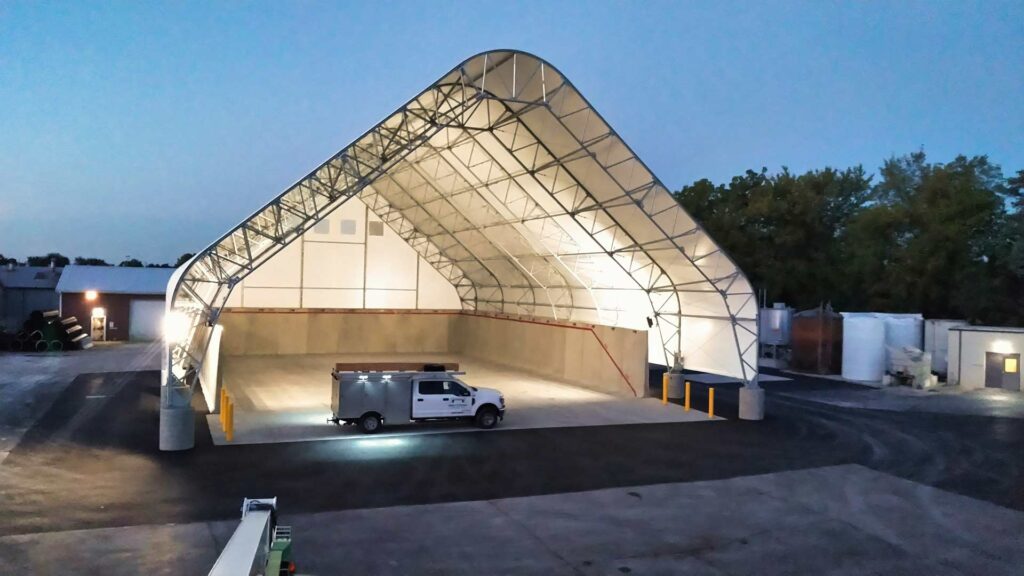
Typically, in a conventional salt and sand storage building, trusses mount directly to the top of the containment wall, placing truss bases at the same level as the salt pile and directly in the path of loader operations.
By contrast, the Magnum Series mounts the frame independently from the containment wall. Trusses stand clear of it, creating separation between the loader’s working zone and the structural frame. As a result, that clearance gives operators room to work without the truss legs becoming a collision risk during normal operations. In practice, the outcome is fewer impact incidents, fewer repairs, and lower maintenance costs. Ultimately, independent truss mounting is one of the most effective decisions a bulk storage facility can make for loader friendly design.
Why Hot Dip Galvanized Trusses Matter in Corrosive Environments
Salt corrodes steel when three conditions exist simultaneously: salt, moisture, and exposed raw steel. In a salt storage building, all three are present by default unless the structural system specifically addresses them.
Hot dip galvanized trusses eliminate the raw steel exposure condition. The hot-dip process immerses fabricated trusses in molten zinc after all welding is complete, coating every surface including welds, edges, and bolt holes. In a corrosion resistant fabric building, that continuous coating performs fundamentally differently from pre-galvanized or painted steel over time. However, pre-galvanized steel leaves welds and cut edges uncoated. As a result, in a salt environment those are exactly the points where corrosion begins, often invisibly from the inside out.
Can the Magnum Series Scale for Other Applications
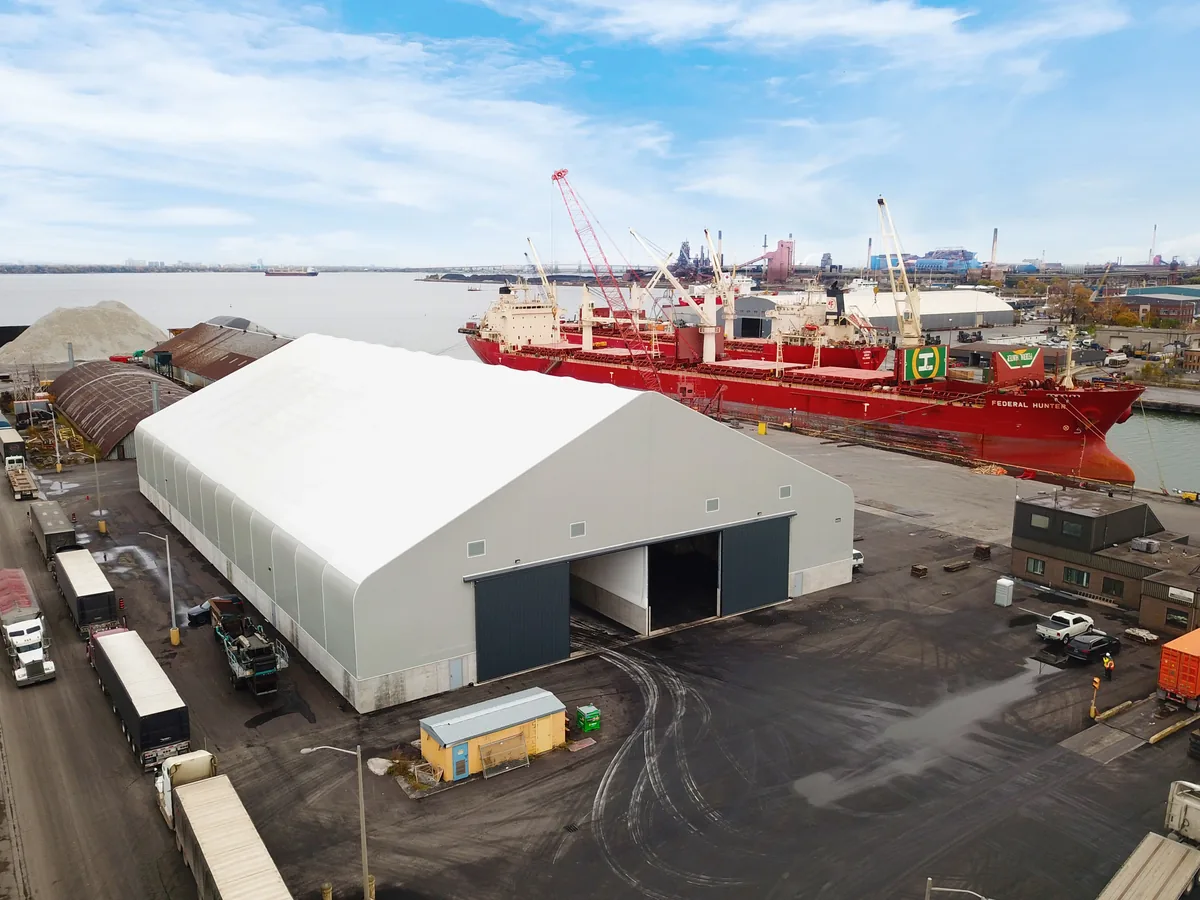
The Magnum was developed for salt and sand storage, but its design characteristics translate directly to other high-throughput bulk material operations. Aggregate storage, compost facilities, transfer stations, and port storage operations share the same core requirements: tall clearances, corrosion resistance, and a cost structure that supports a viable cost per ton over the facility’s operating life.
The building scales in length to match the required tonnage capacity. A full range of accessories, including doors and ventilation systems, lets you configure the Magnum for specific site requirements. Britespan also backs the series with a comprehensive warranty program. A re-cover program supports long-term ownership by extending building service life when the cover reaches end of lifespan.
For commercial fabric building applications including salt and sand storage and warehousing and logistics, the Magnum Series delivers performance that general-purpose structures cannot match. Connect with the Britespan team to discuss what the Magnum can deliver for your site.
Common Questions About the Magnum Series Fabric Building
What vertical clearances does the Magnum Series provide?
The Magnum Series provides 20 feet of vertical clearance at the bunker wall and a dumping lane that is 30 feet wide by 37 feet tall inside the building.
How much can the Magnum Series reduce foundation costs?
By using a pier foundation with independent bunker panels, the Magnum Series can reduce foundation cost by up to 40 percent compared to conventional continuous concrete wall approaches.
Why does independent truss mounting matter?
Independent truss mounting separates the building frame from the containment wall, creating clearance between the loader’s working zone and the structural frame. This reduces impact damage from daily operations and lowers repair costs over the life of the building.
Is the Magnum Series suitable for materials other than salt and sand?
Yes. The tall clearances, corrosion-resistant frame, and cost-effective foundation approach translate directly to aggregate storage, compost facilities, transfer stations, and port storage operations.
Updated: September 21, 2026