
Salt Storage Buildings in the USA: A Complete Guide for Municipal and Commercial Operations
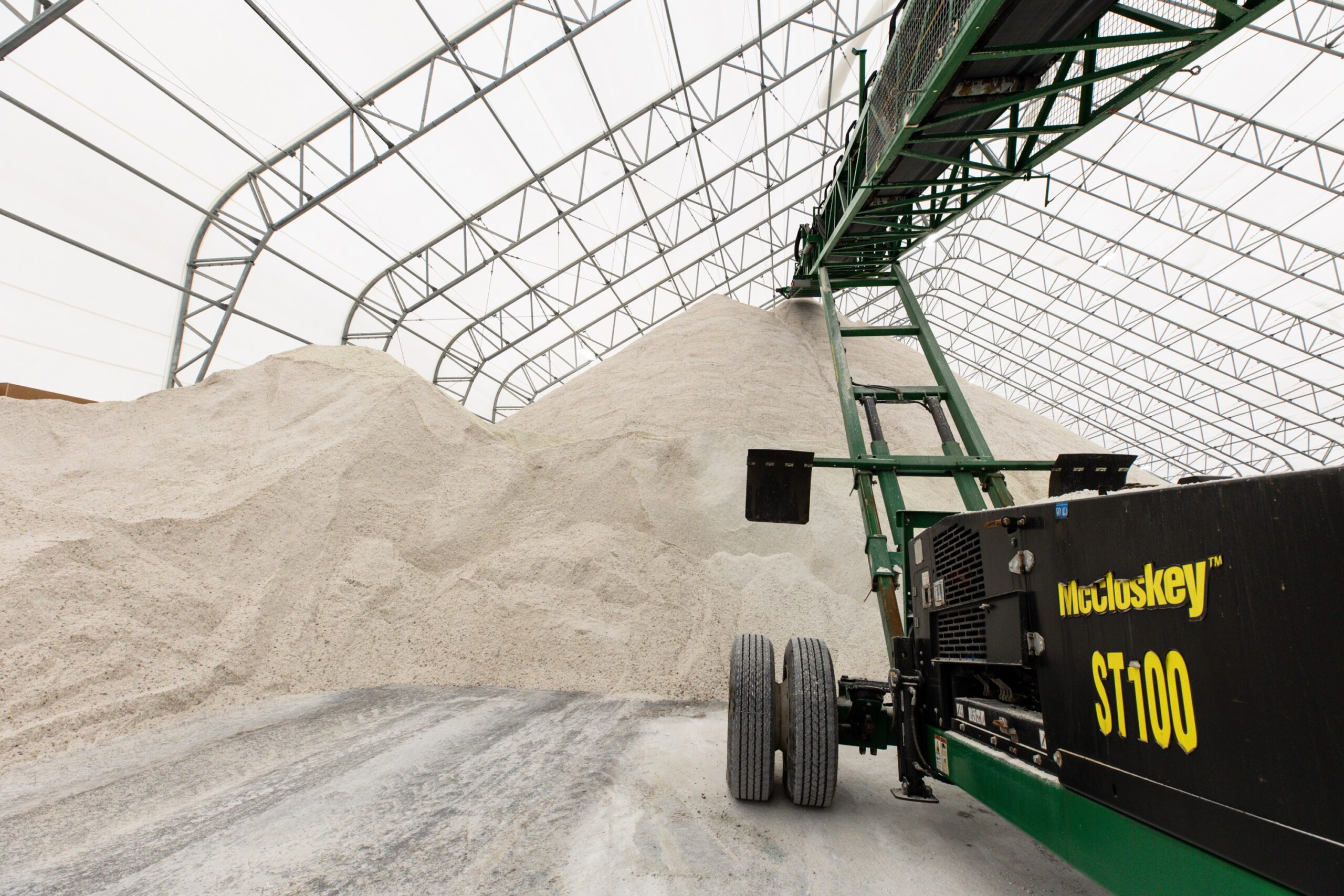
If you manage a state DOT yard, a county highway garage, a city public works department, or a private hauling and de-icing operation, the salt storage building you put up next is going to outlive most of the equipment that uses it. Get it right, and it earns its keep for forty years with just a simple cover replacement and a half-dozen loader generations. Get it wrong, and you spend the next decade fighting corrosion, chasing chloride violations, and writing checks for repairs that should not have been needed.
The stakes are not abstract. The Salt Institute reports that road salting, combined with effective plowing, reduces injury crashes by up to 88%, and that a single major snowstorm that shuts down roads can cost a state between $300 million and $700 million in direct and indirect costs. The salt building is the piece of infrastructure that decides whether you have salt available at three in the morning when the next storm starts. It is worth specifying carefully.
This is a working guide to salt storage buildings in the United States, written for the people who must specify, fund, and operate them. It covers the regulatory floor, the Salt Institute’s site-selection framework, how the three main building types compare, how to size a building from 1,000 tons to 100,000 tons, and where Britespan fabric buildings fit into that picture. Four successful Britespan installations, in Bay City, Michigan; Fulton County and Coshocton, Ohio; and Westmoreland, New York, appear in the project section to ground the rest of the guide in concrete numbers from buildings that are out there working today.
The Quick Answer
In the U.S., almost every state and most local environmental agencies now require road salt and treated de-icing salt to be stored under cover, on an impervious pad, with a stormwater plan that keeps chloride out of the storm system. The three building types in widespread use are wood or concrete salt domes, pole-frame timber sheds, and fabric-covered salt storage buildings.
For new construction at any scale from about 1,000 tons of capacity up through 100,000-plus tons, fabric salt storage buildings deliver the lowest installed cost per ton, the fastest build, the widest clear span for loader access, and the longest service life relative to upfront cost. Domes sometimes make sense in extremely limited site space conditions. Pole-frame sheds still appear in low-cost private yards but rarely make economic sense for municipal or commercial salt operations.
Why Covered Salt Storage Is Now the Standard Across the U.S.
There is no national rule that says, “you must build a salt shed.” There is something stronger than that: a Clean Water Act framework, a state-by-state web of stormwater and groundwater rules, and a settled industry expectation that an uncovered salt pile is a violation in waiting.
There is also a simple material reason. Salt does not lose its ice-melting power in storage, no matter how long it sits, but it does absorb moisture once relative humidity exceeds about 75 percent, and uncovered salt is washed away by every rainfall and every snowmelt that hits the pile. Most producers add anticaking agents at the source, but those agents wash off the outer layer of any pile that is left exposed. Storing salt under cover protects the material itself, the additive coating on it, and the surrounding environment in one move.
The federal floor: NPDES and the Clean Water Act
Public works yards, DOT maintenance facilities, and private contractor sites that store salt are typically covered under the National Pollutant Discharge Elimination System, the federal stormwater program that flows out of the Clean Water Act. Most fall under either an Industrial Stormwater General Permit or a Multi-Sector General Permit, with EPA’s Sector P category covering land transportation, which is where most municipal and DOT salt storage sits. The federal text does not specify a building type. It specifies an outcome: chloride-bearing stormwater is not allowed to leave the site untreated.
That outcome leaves operators with three obligations. The salt must sit on an impervious surface, usually concrete, that does not let chloride percolate down. The pile has to be covered against rain and snowmelt that would otherwise wash it sideways into the storm drain. And the loader-access apron has to drain into something, a sump, a separator, or a treatment train, instead of running to the nearest curb inlet.
State-level salt storage rules
States layer their own requirements on top of the federal floor, and this is where the real specifics live.
The New York State DOT publishes detailed standards for salt storage facilities in its highway design manual, including minimum roof type, pad slope, segregation between treated and untreated salt, and apron drainage. A municipality contracting with NYSDOT or storing salt for state-maintained roads typically builds to those specs even when the local code would allow less.
Minnesota’s Smart Salting program runs through the Minnesota Pollution Control Agency and effectively expects covered storage on any winter-maintenance site over a small capacity threshold, plus operator certification that touches loading practices, pile management, and runoff handling.
Massachusetts requires covered storage on any salt pile over ten tons that sits within a Zone II wellhead protection area, and a large fraction of the state’s road network falls inside one. The result is that “covered storage” is the practical default in Massachusetts, even where the strict letter of the rule might allow exposure.
Wisconsin’s Department of Natural Resources treats an uncovered salt pile as a regulated stormwater discharge requiring a permit and a documented best-management practice. Maine’s Department of Environmental Protection runs a Sand and Salt Pile Program that prescribes specific pad and roof requirements before a new pile area can be established.
If you are operating in a state we have not named, two phone calls usually get you the spec you need: one to your state DOT maintenance division, one to your state environmental agency’s stormwater desk. Both will tell you what they expect to see when they walk the site. Neither conversation takes long.
What an inspector looks for
After the building is up, the day-to-day compliance question is not the structure itself but the operations around it. Inspectors look at five things: that the salt is fully under cover with no piles spilling out the door overnight, that the concrete pad is intact and not cracked through to bare ground, that the apron drains to a separator or a closed sump and not to a stormwater inlet, that loader operators are trained to push salt back inside before leaving for the day, and that the salt and any pre-treated blends are stored in a way that does not let them mix accidentally. The building enables every one of those, but it does not replace any of them.
Site Selection: The Salt Institute’s S-A-L-T-E-D Framework
The Salt Institute’s Salt Storage Handbook uses a six-letter acronym, S-A-L-T-E-D, to anchor the site-selection conversation. The framework has held up for decades because it forces operators to think through the considerations that get skipped when a site is chosen primarily on cost or convenience.
Safety: Equipment operators need good visibility in all directions. Access roads should not open directly into heavily travelled routes. The site should be fenced or otherwise secured against unauthorized entry, including by children, who are often attracted to salt piles and can be hurt by them.
Accessibility: The site has to permit easy truck and loader access during storm conditions when visibility is poor. Door openings on a salt building should be a minimum of 20 feet wide. The maneuvering room should be at least twice the length of the longest delivery truck. Most large salt trailers run 48 feet long, and some run 55 feet, so plan for 100 to 110 feet of working space behind the door.
Legality: The site has to satisfy local zoning, plus state and federal environmental discharge regulations. This is where the NPDES and state-level rules above become operational. Confirm the requirements before you commit to a site, not after.
Tidiness: The building and its surroundings should look kept-up, especially in residential areas. Salt spilled during delivery or loading should be returned to the building as quickly as possible, both because it is product going to waste and because piles of spilled salt around a yard read as “this operation is not careful.”
Economics: Locate and distribute storage so that empty trucks do not have to deadhead long distances back to a central yard to reload. This sounds operational, not architectural, but it is one of the largest determinants of total cost over a building’s life.
Drainage: Locate the building so that surface water flows away from the pile, not toward it. The Salt Institute’s handbook recommends a pad slope of one-quarter inch per foot away from the center, with a minimum slope of one to two percent. The site must not drain into a freshwater reservoir, well, or groundwater supply. Where needed, install curbing, ditches, pipes, or tile to direct runoff to a properly designed sump or separator. Brine collected at the sump can be reapplied to the pile during dry weather or used to pre-wet spreader loads. Confirm any disposal procedure with state and local environmental agencies before you act on it.
These six factors interact. A site that scores well on accessibility and economics but cannot satisfy drainage is a non-starter, and so is a perfect drainage site that puts loaders three minutes from the road system they serve. Walk through all six on every candidate site.
How Much Salt Are We Really Talking About?
The U.S. uses roughly twenty million tons of road salt every winter compared to just 5,000 tons in the 1940s, with the heaviest concentration across the northern tier from Minnesota through New England, plus a long mid-Atlantic and Mountain West tail. Per Clear Roads, the joint state DOT pooled-fund research program, the annual tonnage moves with winter severity, and the average has been climbing as more municipalities apply pre-wet brines and treated salt blends.
The Salt Institute’s standing recommendation is to provide storage for at least 100 percent of the estimated average winter’s salt requirements, sized off five-to-ten-year averages rather than last winter’s number. That guideline is conservative for a reason: it removes the possibility that a mid-winter supply hiccup turns into a service failure, and it lets the operation take advantage of off-season delivery when haulage and supplier capacity are not stretched.
Broken down, the sizing logic gets specific.
For a typical northern U.S. municipality, road salt usage runs about 10 to 25 tons per lane-mile per winter, depending on storm count, treatment policy, and whether the operator is running anti-icing brines that reduce dry-salt application rates. A town plowing 80 lane-miles at a moderate application rate is in the range of 1,000 to 2,000 tons per season. A mid-sized city with 400 lane-miles can easily hit 6,000 to 10,000 tons.
For a state DOT regional yard, the numbers scale up sharply. A district yard serving a few hundred lane-miles of state highway routinely stores between 5,000 and 25,000 tons. The largest DOT and turnpike yards are over 50,000 tons in a single building.
For a commercial operator, a private contractor running de-icing service for shopping centers, distribution warehouses, hospital campuses, and corporate headquarters across a metro area, storage requirements depend less on plowed lane-miles than on customer count and weather risk. A firm covering 200 commercial accounts in the Midwest typically wants 3,000 to 8,000 tons of resilient inventory before peak season. Hauling and bulk-distribution businesses that deliver salt to municipalities often go larger still. The TJ Allen Trucking project featured later in this guide stores well over 100,000 tons under one Britespan roof.
After the supply crunch in the 2022 to 2023 season, most of the DOT and commercial customers we work with moved their storage targets up. Some tripled them. The Salt Institute’s 100-percent-of-seasonal-need rule of thumb is the floor, not the ceiling.
The Three Building Types Used for Salt Storage in the U.S.
Three building types do almost all the work in the U.S. salt storage market today, plus a fourth, uncovered piles under tarp, which is no longer a serious option for any operation that wants to stay compliant and is not addressed below.
Salt domes are circular wood-frame or concrete-frame structures with a continuous arched roof. The dome geometry lets the loader push salt up against the apex, and the salt itself becomes part of the wall structure. The pile leans outward against the inner surface of the wall, which transfers load through the arch the same way contents transfer load through a grain bin. Wood domes typically last twenty-five to thirty-five years if maintained, and concrete domes longer. They are the right answer when the building has to look like part of a streetscape, when the site is small enough that a circular footprint fits where a rectangle would not, and when the budget can absorb the higher per-ton-stored cost.
Pole-frame timber sheds are conventional post-frame ag-style buildings adapted for salt. Treated wood columns, metal roofing on purlins, an open front for loader access, and sometimes timber bunker walls inside. They are cheap upfront and fast to build. The tradeoff is what salt does to wood and steel over time. We routinely see pole-frame salt sheds where the columns nearest the front opening have rotted at the base by year twelve, the metal roof has corroded along the salt-line on the underside, and the building is being patched annually. Many municipalities have moved away from pole-frame for new salt storage even though they keep using it for general-purpose ag and equipment buildings.
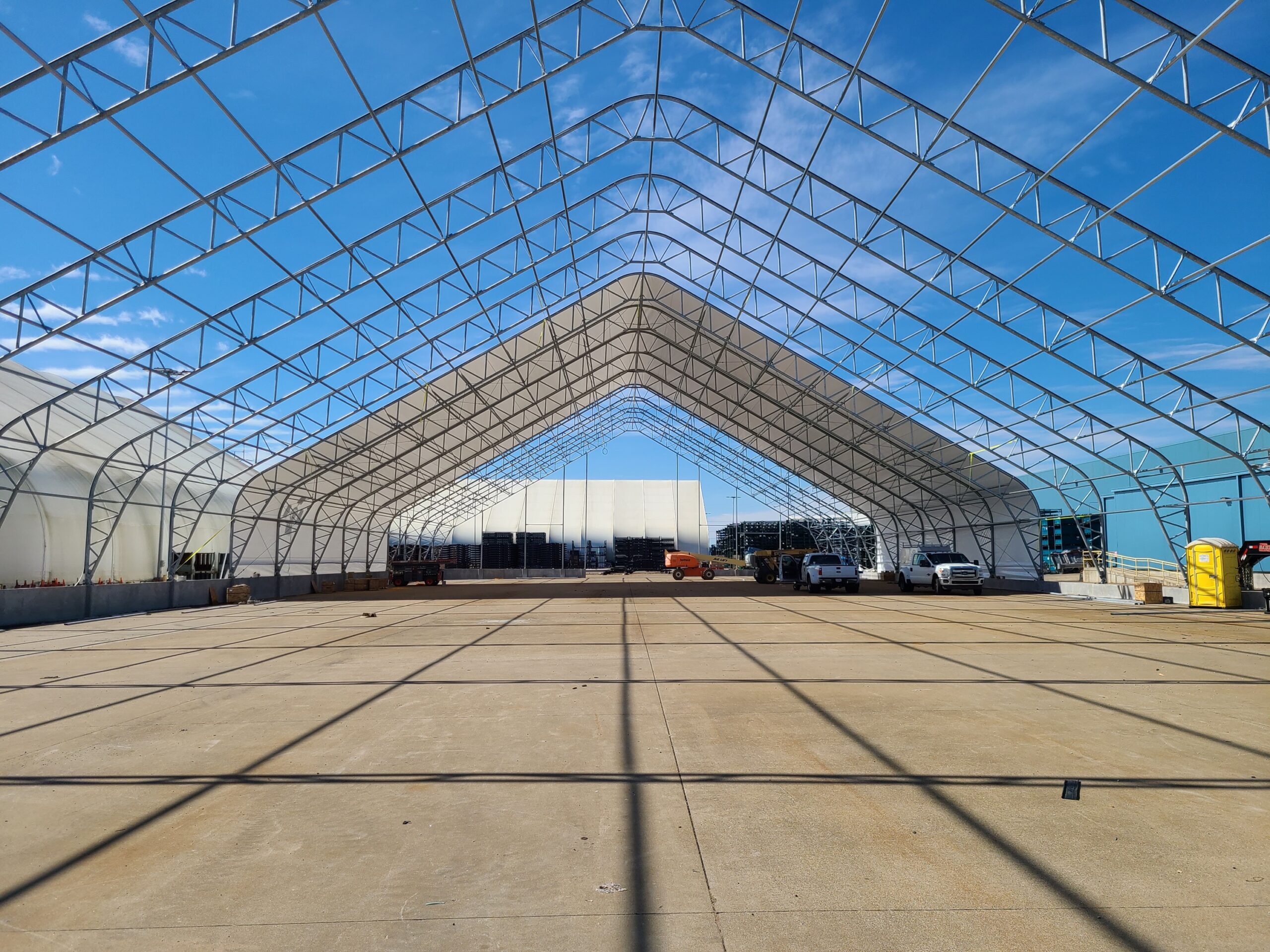
Fabric salt storage buildings use a hot-dipped galvanized steel truss frame covered with tensioned high-density polyethylene fabric, sitting on either concrete piers, tilt-up concrete blocks, or a poured concrete knee wall. Clear spans of 60 to 200 feet are routine. The fabric envelope handles the salt-laden interior atmosphere far better than wood or steel decking does, because there is nothing inside the cover for chloride to corrode. The fabric is a polymer, the frame is galvanized and lives above the splash zone, and the bunker wall is concrete. These are the buildings most new municipal and commercial salt projects in the U.S. now go up as.
Why Fabric Has Become the Default for New Salt Storage Builds
Five reasons, in roughly the order they show up in a buyer’s spreadsheet.
Corrosion behaviour: Salt-laden humid air punishes everything it touches. Wood rots, exposed steel pits, fasteners fail, and painted surfaces flake. A fabric building is built around that reality. The polyethylene fabric does not corrode. The galvanized truss frame, when sized so the lower chord lives above the salt pile and the column bases are protected by the bunker wall, is not in the splash zone. Fasteners that touch salt are stainless. The Magnum Series we use for purpose-built salt storage takes this further by setting the truss piers outside the bunker walls entirely, so the structural members never share air space with the salt.
Clear span and loader access: A 60-foot articulated loader with a 6-yard bucket does not work in a building with internal posts. Fabric truss systems span that comfortably and routinely run wider. 80 feet is a common municipal width, 100 feet is standard for commercial bulk operations, and 160-foot to 200-foot spans handle the largest hauling and DOT distribution yards. The wider the clear span, the fewer building footprints you need to cover the same tonnage.
Cost per ton stored: Across the dozen-plus salt projects we benchmarked when writing this guide, fabric came in between fifteen and thirty dollars per square foot of covered area installed, which works out to roughly ten to twenty-five dollars per ton of stored capacity at typical pile heights. Domes ran roughly thirty to fifty dollars per ton stored. Pole-frame sheds sometimes came in at twelve to twenty dollars per ton stored upfront, but the lifecycle cost, including the rebuild we have watched pole-frame customers do at year fifteen to twenty, closes most of that gap. Treat these as planning ranges; current pricing varies by region, steel market, and project specifics, and a real quote should always be benchmarked.
Build speed: Fabric salt buildings typically install in two to six weeks to install once the foundation is in. Domes run eight to sixteen weeks. Pole-frame falls between, depending on weather and crew availability. For a municipality that has just lost its salt shed to a roof failure in October, build speed is not an abstract spreadsheet number. It is whether the salt comes inside before the first storm.
Re-skin lifecycle versus rebuild: This one matters more than most first-time buyers realize. A fabric cover lasts roughly eighteen to twenty-two years on a salt building, depending on application and exposure. When the cover finishes its life, the galvanized frame stays. You reskin the building in one to three weeks for roughly a third of the cost of new construction, and the building runs another twenty years. A pole-frame shed at end-of-life requires a full rebuild. A salt dome can be re-roofed, but the underlying timber structure is harder to inspect and replace. Lifecycle math favours fabric over a forty-year horizon almost every time.
Sizing a Salt Storage Building from 1,000 Tons to 100,000+ Tons
Sizing a salt building comes down to three numbers: how many tons, how high the pile, and how much loader maneuvering room around the pile. The Salt Institute publishes the underlying physical constants and they do not move:
- Bulk salt density runs from 72 pounds per cubic foot loose to 84 pounds per cubic foot compacted. Use 80 pounds per cubic foot for design calculations.
- One ton of salt occupies roughly 25 cubic feet of storage space (about 21 cubic meters per metric ton).
- The natural angle of repose of deicing salt is 32 degrees.
From there, the rest is geometry.
| Storage capacity | Typical building size | Eave height | Frame span | Common applications |
|---|---|---|---|---|
| 500 to 1,500 tons | 50×60 to 60×80 | 16 to 18 ft | 50 to 60 ft | Small towns, public works yards, golf courses |
| 1,500 to 4,000 tons | 60×100 to 80×100 | 18 to 22 ft | 60 to 80 ft | Mid-sized municipalities, county garages |
| 4,000 to 10,000 tons | 80×120 to 100×160 | 20 to 24 ft | 80 to 100 ft | Large cities, county yards, commercial contractors |
| 10,000 to 25,000 tons | 100×200 to 120×300 | 22 to 26 ft | 100 to 120 ft | DOT regional yards, regional contractors |
| 25,000 to 100,000+ tons | 160×300 to 160×800+ | 26 to 32 ft | 150 to 200+ ft | DOT districts, salt haulers, port-side bulk distribution |
A few numbers worth carrying around mentally. A 60-by-100 building with 22-foot eaves and a 32-degree pile angle stores roughly 2,500 tons of bulk salt with a sensible loader room. An 80-by-120 building at 22-foot eaves stores 4,500 to 5,500 tons, depending on how aggressively the operator pushes salt up the bunker walls. A 100-by-200 building at 24-foot eaves stores around 12,000 to 14,000 tons. Past that point, once you are building 160 feet wide and several hundred feet long, pile geometry starts to favour a building tall enough to let the loader push salt to the apex, and eaves go from twenty-six to thirty-two feet.
Eave height is where the most preventable mistakes happen. A 14-foot or 16-foot eave was standard a generation ago, when the loader was a smaller wheel loader, and the operator pushed salt against a four-foot bunker wall. Modern articulated loaders push salt against eight-foot to ten-foot bunker walls and need overhead clearance for a fully raised bucket. Specifying 18 feet of eave on what looks like a small building, or 22 feet on a mid-sized one, costs almost nothing at quote time and pays back across every loader cycle for the next forty years.
Bunker wall height drives storage volume more than building width does. Eight-foot ecology blocks are typical. Some operations stack to ten or twelve feet, which materially raises pile capacity inside the same footprint. Engineering the wall for that load requires the right block, the right keying, and the right backfill. If it is being engineered for ten-foot stacking, the loader path inside has to support it.
Foundation Options That Match Your Site
Salt buildings sit on one of four foundation systems, and the choice is usually driven by site conditions, capacity target, and budget rather than preference.
Concrete piers support the building columns at fixed intervals and let the bunker wall do the lateral retention work separately. They are common on the Magnum Series because the truss piers can be set outside the bunker wall, isolating the structural frame from salt exposure entirely. Piers are the most engineering-flexible option and the right call on most permanent municipal and DOT installations.
Tilt-up concrete blocks, sometimes called ecology blocks or interlocking concrete blocks, get used both as bunker walls and as a foundation system in their own right on smaller buildings. They are fast to install, can be reconfigured later, and allow the building to be relocated without abandoning the foundation. The tradeoff is engineered load capacity, which limits the spans and pile heights this system supports.
Existing concrete pads are common on retrofits, where a municipality has had an open salt pile on a slab and is now adding a building over it. The slab needs to be evaluated for thickness, reinforcement, and edge condition before a building is pinned to it. We have helped customers turn 25-year-old slabs into the foundations for new fabric buildings; we have also walked away from slabs that did not have the structural reserve to take it.
Poured concrete knee walls are the high-end option, a continuous concrete wall four to ten feet tall that serves as both the bunker wall and the column base in one pour. It is the most expensive foundation per foot and the most permanent. State DOT yards going up under a forty-year facility plan often specify it.
Whatever foundation type is chosen, slope the pad to drain. The Salt Institute’s recommended pad slope is one-quarter inch per foot away from the center of the pile, with a minimum slope of one to two percent. Where local topography does not permit that, use ditches, pipes, or asphalt berms to channel surface water to a designed sump rather than letting it find its own path.
Engineered for Snow and Wind: Design Loads That Actually Matter
The Salt Institute’s handbook has long recommended that any salt storage building be designed for at least 25 pounds per square foot of roof snow load and an 80-mile-per-hour wind. Those numbers are a national floor, not a regional answer. Britespan’s salt storage buildings are engineered to the snow and wind loads required by the local building code at the project address, which in most of the northern U.S. and Canadian markets is materially higher than the handbook floor.
Two practical points fall out of this. First, a “national” or “off-the-shelf” salt building that has not been engineered to your site is the wrong building. Second, the specific design considerations on a salt project go beyond the headline snow and wind numbers: anchorage of the columns to the foundation, knee bracing, the connection of rafters to purlins, the lateral load from the loader pushing into the pile, and the pressure differential when the door is open during a storm. A reputable manufacturer will document each of these in the engineering package; it is worth reading.
Where there is interior loader traffic, the inside face of the bunker wall needs protection. The Salt Institute recommends covering the pressure-wall framing from the floor up with two-by-twelve boards (or equivalent) so that loader buckets do not damage the structural supports. On Britespan installations, the bunker wall itself usually does this work because it is concrete; on hybrid wood or steel walls in older sheds, the protective sleeve is what stands between you and an expensive wall repair.
Britespan Salt Storage Buildings: The Four Series Used in the USA
Britespan ships four building series into U.S. salt storage projects. They are not interchangeable. Each has a job.
Apex Series: The general-purpose commercial building. Apex covers salt and sand storage, equipment storage, commodity buildings, and warehousing. It is the right fit for commercial operators who want a high-quality fabric building without the salt-specific engineering of the Magnum. Most commercial salt yards under 6,000 tons in the U.S. that we have built are Apex.
Atlas Series: A heavier-duty commercial and industrial building, available with 12 oz/yd² or 13.5 oz/yd² high-density polyethylene fabric, in flame-retardant and non-flame-retardant versions. Atlas is the workhorse for sand and salt storage projects that want heavier fabric than the standard, and for operators that need flame-retardant fabric to satisfy local code. Sand-and-salt mixes, common in colder regions where straight salt is supplemented with grit, go in Atlas buildings as a default.
Magnum Series: Britespan’s purpose-built salt storage building. The defining feature is that the truss frame piers sit outside the bunker walls. The structural members never share air with the salt. This is the engineering answer to the corrosion problem that historically gave salt-storage operators headaches with steel-frame buildings. Fulton County, Ohio, runs a Magnum. Many of the state DOT and county-level salt sheds we install are Magnums.
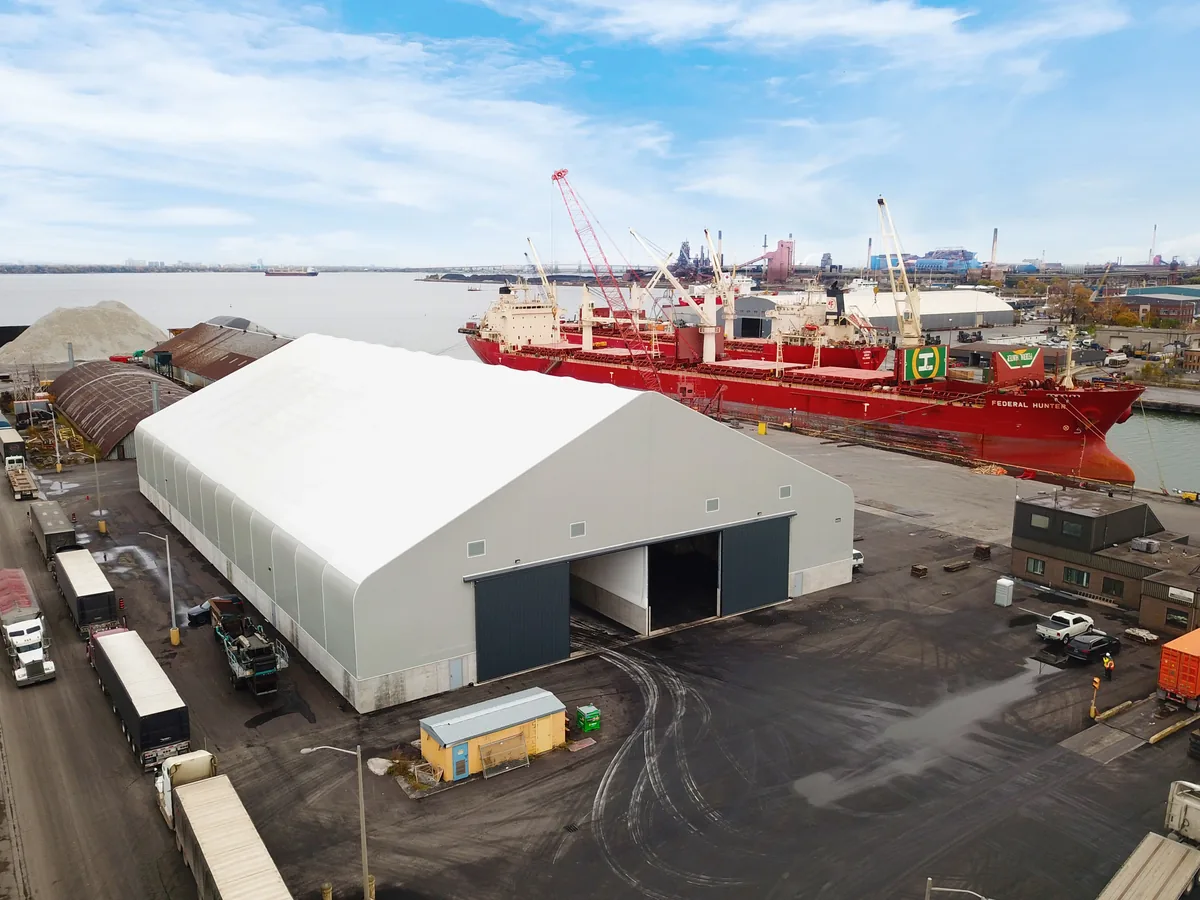
Genesis Series: The large-scale building. Genesis spans go up to 210 feet, and lengths run to whatever site geometry supports. It is the building for hauling operations, regional bulk distribution, port-side salt import yards, and DOT district facilities that need to consolidate storage from multiple smaller buildings into one. The TJ Allen Trucking project in Westmoreland, New York, is a Genesis at 160 feet wide.
U.S. Salt Storage Projects in the Field
Four projects, four different operating profiles, four different parts of the country.
TJ Allen Trucking, Westmoreland, New York
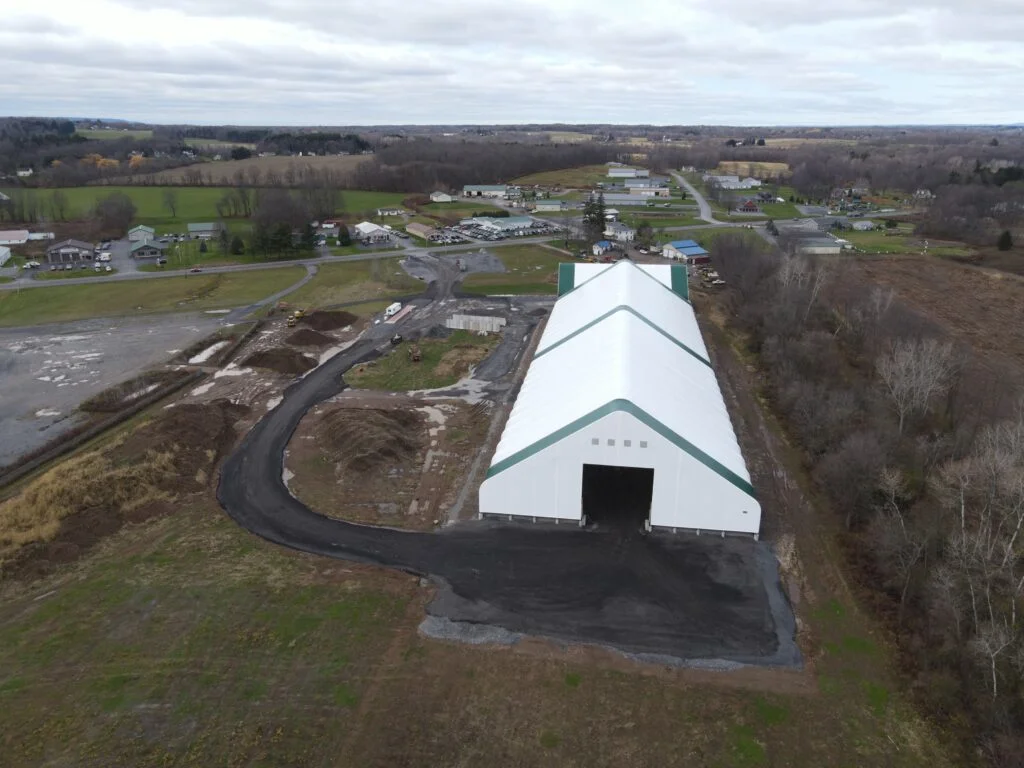
TJ Allen, 160 Wide, 480 Long, Genesis, Salt Storage
TJ Allen Bulk Services is a regional salt distributor operating out of Westmoreland, in central New York. The company moves de-icing road salt, agricultural lime, sand, stone, and bagged products to municipal and commercial customers across the Northeast. The Britespan Genesis Series salt storage building on the TJ Allen yard is 160 feet wide by 480 feet long, on a concrete pier foundation, and stores well over 100,000 tons of salt under a single roof.
What is notable about this project is the consolidation it represents. Before the Genesis went up, the same volume of salt would have required several smaller buildings, multiple footprints, multiple drainage areas, and multiple loader cycles to move material between buildings. One Genesis, one apron, one drainage plan. The 160-foot clear span lets a 950-class wheel loader operate inside without touching a column. The pier foundation isolates the structure from the bunker wall, which means the salt pile and the building frame do their separate jobs. This is the kind of building that makes a hauler economically competitive with rail-served distributors, because per-ton storage cost runs lower at 100,000-plus tons than it does at any smaller scale.
Bay City, Michigan, 80 by 120 Apex Commercial Salt Storage
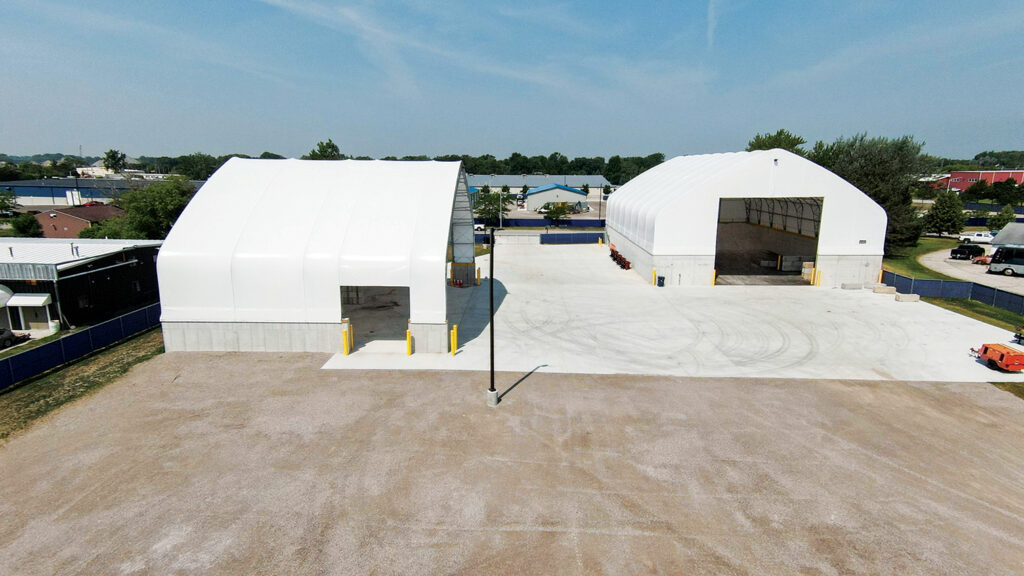
Bay City Public Works 80′ x 120′ L10′ Apex Commercial Salt Storage_Poured Wall Foundation_SO 9308_Clear Heights Construction_2023_001
Bay City sits at the head of the Saginaw Bay on Michigan’s east coast. The Apex Series salt building on this commercial site is 80 feet wide by 120 feet long, sized for somewhere between 4,500 and 5,500 tons of capacity at an 8-foot bunker wall and a 22-foot eave. This is a typical mid-scale commercial salt operation: enough capacity to ride out a full Michigan winter without re-stocking, enough loader room to push salt against three walls, and a footprint that fits inside a normal yard without consuming the whole site. Buildings like this one are the bread and butter of the commercial salt-storage market in the upper Midwest and Great Lakes region.
Fulton County, Ohio, 80 by 120 Magnum Fabric Building
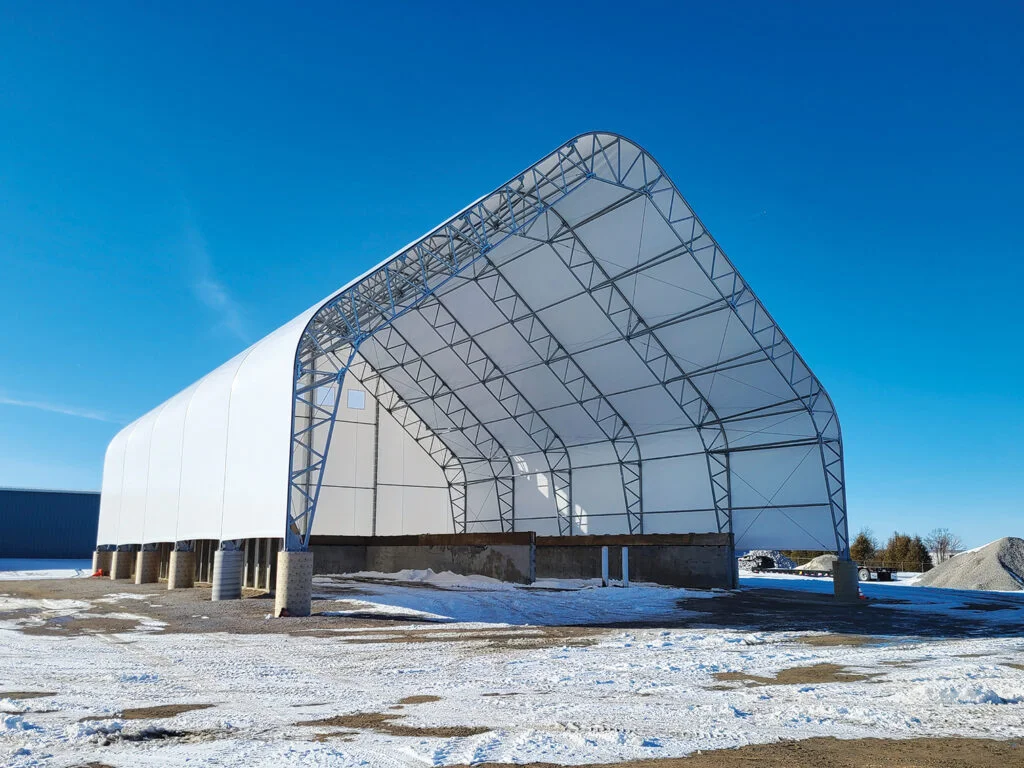
Fulton County Greystone Ohio Department of Transportation ODOT
Fulton County is in northwest Ohio, near the Michigan and Indiana borders. The Magnum Series building here is also 80 by 120, but the engineering is fundamentally different from the Bay City Apex. The Magnum’s truss piers sit outside the concrete bunker walls, meaning the structural steel never enters the salt envelope. For a county highway department running salt operations on a forty-year planning horizon, that detail changes the maintenance math.
There is no annual frame inspection for chloride pitting because the frame is not in a chloride. The bunker walls take the salt; the building takes the weather. The two systems do not meet. This is the building most county engineers in the Great Lakes region we have worked with end up specifying.
Coshocton, Ohio, 80 by 100 Atlas Sand and Salt Storage
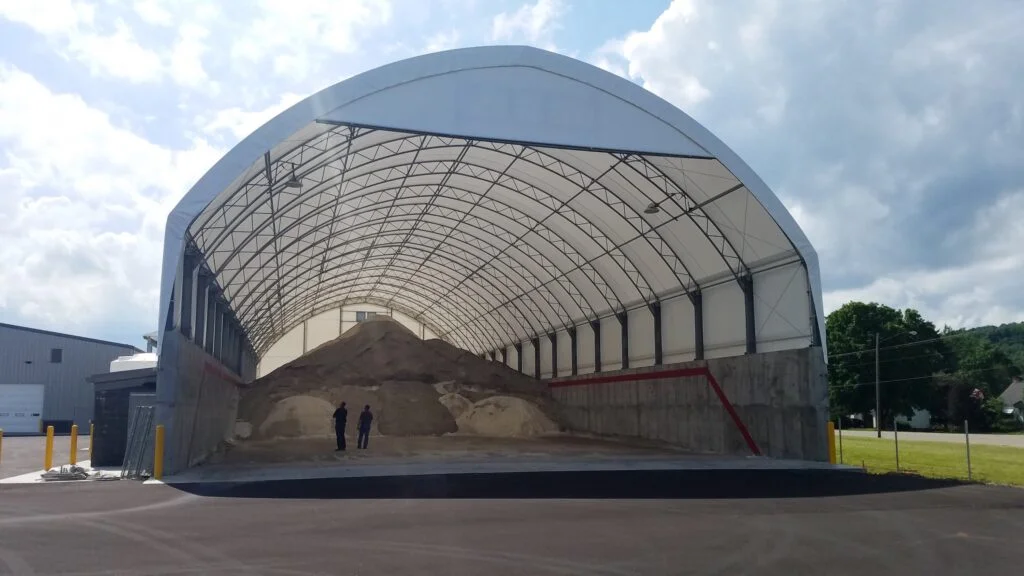
80 Wide, 100 Long, Atlas, Salt, Sand, Storage, Coshocton, OH, Ohio
Coshocton sits in east-central Ohio. The Atlas Series building on this site is 80 feet wide by 100 feet long, configured for sand-and-salt mix rather than straight de-icing salt. That changes a few specs. The fabric is heavier (Atlas is available with 12 oz or 13.5 oz HDPE) because sand and grit can abrade lighter fabric over time during loader operations.
The bunker walls are slightly higher than a pure-salt building, because sand piles to a steeper angle than salt and the wall height drives capacity. Eaves come down to 18 to 20 feet on this size building, which still gives the loader the working clearance it needs. For operators running winter sand mixes on rural roads where straight salt is overkill, Atlas in this size range is the right answer.
Project specifications at a glance
| Project | Location | Series | Dimensions | Notes |
|---|---|---|---|---|
| TJ Allen Trucking | Westmoreland, NY | Genesis | 160 × 480 ft | 100,000+ tons; concrete pier foundation |
| Commercial Salt Storage | Bay City, MI | Apex | 80 × 120 ft | 4,500 to 5,500-ton mid-scale commercial yard |
| County Salt Storage | Fulton County, OH | Magnum | 80 × 120 ft | Truss piers outside the bunker walls |
| Sand & Salt Storage | Coshocton, OH | Atlas | 80 × 100 ft | Heavier fabric for sand-salt blends |
Fabric Specifics That Matter for Salt
Inside the building, the cover is doing most of the work. A few specifications that change real-world performance:
The fabric weight is the first one. Britespan’s salt-storage builds use 12 oz/yd² high-density polyethylene as a baseline, with 13.5 oz/yd² available on the Atlas Series for sand-salt mixes and operations where loader operators occasionally clip the cover at the corners. Lighter weights of 8 to 10 oz exist in the market and last a few years, but they do not take the daily abuse a salt operation puts a building through. The cost difference between 12 oz and a lighter fabric is small. The durability difference is not.
UV behavior is the second. Salt-storage buildings sit in full southern exposure most of the year. A high-grade UV-stabilized polyethylene cover holds its tensile strength through eighteen to twenty-two years before re-skin is needed. Lower-grade fabrics lose tensile strength at the seams and panel edges first, and they show it as visible degradation along the south face years before the rest of the cover is at end of life.
Flame retardancy is the third. Many state and local fire codes do not require flame-retardant fabric for salt storage, but some do, particularly in commercial yards adjacent to fueling, or in indoor sites where multiple buildings sit close to one another. The Atlas Series and several other Britespan series are available in flame-retardant and non-flame-retardant fabric depending on what local code calls for.
The re-skin cycle is the fourth, and it is the spec that ends up mattering most over a forty-year horizon. When the cover reaches end of life, the galvanized frame stays, the bunker walls stay, the foundation stays, and a new cover goes on in roughly one to three weeks. The cost is roughly one-third of new construction. Most fabric salt storage buildings in the U.S. will see two or three re-skins across their service life. Customers who plan for that lifecycle from day one budget for it; customers who do not get surprised by it. Build the re-skin into the facility’s capital plan from the start.
Specifying the Salt Itself: ASTM D632 and AASHTO M143
The building decision is one half of a real procurement. The other half is what gets stored inside it. The standing North American specification for road salt is ASTM D632, with an equivalent AASHTO designation of M143. The standard requires sodium chloride content of at least 95.0% and defines two gradation types and grades for different operational uses (Type I for pavement deicing or aggregate stabilization, Type II for stabilization or other purposes). Specify the standard by designation rather than by year so the current revision applies automatically.
This matters for storage in three ways. First, salt that meets ASTM D632 arrives in free-flowing condition, which is what your loaders are sized for. Second, the spec controls anti-caking treatment and gradation, which directly affect how the pile behaves under cover. Third, knowing the spec lets you push back on a delivery that does not meet it, before it ends up in your building.
Common Mistakes We See on U.S. Salt Storage Projects
Mistakes show up over and over again, across both municipal and commercial projects, regardless of building type.
- Undersizing the apron: The concrete pad has to extend 20 to 30 feet past the door opening so the loader does not drag salt onto bare ground every time it leaves. This sounds obvious and gets missed routinely.
- Ignoring apron drainage: Even a fully covered pile generates apron runoff. Snow comes off the loader’s tires and tracks, melts on the apron, picks up chloride that has been tracked out, and runs to the nearest drain. An oil-water-and-chloride separator on the apron drain is what most state environmental agencies want to see and what an inspector will ask about.
- Skipping the bulkhead between treated and untreated salt: If the operation runs both rock salt and a pre-treated blend with calcium chloride or magnesium chloride, the two need separate bays. Mixing untreated salt into a treated pile by accident wastes the treatment additive and confuses the application rate.
- Building too low at the eaves: A 14- or 16-foot eave was right when the loader was smaller and the bunker wall shorter. It is not right today. Eaves on a modern salt building should start at 18 feet for the smallest sizes and climb from there.
- Door openings under 20 feet wide: The Salt Institute’s minimum is a 20-foot door opening, and that minimum exists for a reason. A 16- or 18-foot door slows every loader cycle and turns into a real problem when a delivery truck has to back into a building under a tight clearance margin. Specify 20 feet as the floor and go wider on larger buildings.
- Choosing the cheapest fabric: A 12 oz/yd² PE fabric is the floor for a real salt building. Lighter is false economy.
- Forgetting ventilation: A salt building needs to manage interior humidity. Salt absorbs moisture from the air above 75 percent relative humidity, clumps, and becomes harder to load and harder to apply. Ridge vents, soffit vents, and sometimes powered ventilation get specified during the design phase. Skipping ventilation to save a few thousand dollars during construction is the kind of small mistake that compounds across every winter the building is in service.
- Locating the building wrong on the site: The salt building should sit downwind of administrative buildings if possible, with the loader-access opening facing the staging area and away from the prevailing winter wind. This is geometry, not engineering, and it gets overlooked.
- Treating stockpile safety as common sense: It is not. The Salt Institute recommends never approaching the vertical face of a pile (on foot or in a vehicle) closer than the vertical height of the pile itself, because of avalanche risk. Never park next to a pile or between a pile face and an immovable object. When working on top of a pile, never approach the crest closer than 15 feet, and watch for sinkholes in the surface. Brief every operator who works the building on these rules, and refresh annually.
Planning Timeline for a New Salt Storage Building
For a typical municipal or commercial project, the realistic timeline from “we need to do this” to “salt is inside” runs four to nine months. Three months of planning, design, permitting, and procurement; two to four weeks of foundation construction; two to six weeks of building erection; one to two weeks of commissioning, drainage tie-in, and inspection. Projects that start in March or April are inside their building well before the first October storm.
Projects that start in July often miss the season and stage salt outside under tarp for one winter, which is rarely what anyone wants. The Salt Institute’s procurement advice is consistent with what we tell our customers: plan in summer for the following winter, and order salt early so the building is full before peak demand.
Frequently Asked Questions
Are fabric salt storage buildings really durable enough for a long-term municipal or commercial operation?
Yes, when the building is engineered for the application. The galvanized steel frame is rated for forty-plus years of service, and the cover is replaced on a roughly twenty-year cycle for about a third of the cost of new construction. This is the same lifecycle pattern that wood salt domes use. The structure outlasts the roofing surface, and the roofing surface gets replaced when it reaches end of life.
How does the cost of a fabric salt storage building compare to a salt dome?
For a typical 5,000-ton building, a fabric structure runs roughly $250,000 to $450,000 installed, while a comparable salt dome runs $400,000 to $700,000. The gap widens at larger capacities. Domes can still be the right answer for high-visibility streetscape sites where the building’s appearance matters, and for sites where a circular footprint fits better than a rectangle. Treat both ranges as planning numbers and benchmark against current quotes before committing.
What is the largest single salt storage building Britespan has built in the U.S.?
The Genesis Series building for TJ Allen Trucking in Westmoreland, New York, at 160 feet wide and 480 feet long, is one of the largest. It stores well over 100,000 tons of salt under one roof. Genesis spans go up to 210 feet wide, and lengths are limited only by site geometry.
Can a fabric salt storage building be put on an existing concrete pad?
Often yes, depending on the slab’s thickness, reinforcement, and edge condition. Many municipalities have used existing pads as the foundation for new fabric buildings, which both saves cost and accelerates the build. The slab needs to be evaluated by the engineering team before it is committed to.
How long does a fabric salt storage building take to put up?
Two to six weeks of on-site erection once the foundation is ready, depending on building size and site conditions. The total project, including foundation work, typically runs three to four months from contract to commissioning.
What kind of permit do I need for a salt storage building?
A local building permit is required as for any new structure. In addition, the facility’s stormwater pollution prevention plan under NPDES coverage typically needs to be updated to reflect the new building, the new apron, and any changes to drainage. Some states require notification to the state environmental agency before construction. Your dealer or installer can help with the specifics.
Does a salt storage building need ventilation?
Yes. Passive ridge and soffit ventilation is standard on most fabric salt buildings. Salt absorbs atmospheric moisture above 75 percent relative humidity and clumps if the interior gets too humid, which makes it harder to load and harder to spread evenly. Ventilation is engineered into the design rather than added later.
How much salt should I order for the season?
The Salt Institute recommends storing at least 100 percent of the average winter’s needs, sized off a five-to-ten-year average rather than last year’s number, and ordered in summer or early fall so the building is full before peak demand. Specify product to ASTM D632 (equivalent AASHTO M143), with a minimum 95.0 percent sodium chloride content, and let the standard’s current revision apply automatically.
Ready to Plan Your Salt Storage Building?
If you are sizing a salt storage facility for a state DOT yard, a county highway garage, a municipal public works department, a private de-icing contractor, or a regional bulk hauler, the most useful first step is a sizing conversation. How many tons? How often the building is accessed. What your state environmental agency expects on the runoff side. What the site looks like on the six S-A-L-T-E-D criteria. Pad or no pad, downwind or upwind of administrative buildings, single-door or drive-through.
Britespan has installed salt storage buildings across the U.S. and Canada in capacities from 500 to 100,000-plus tons, in the Apex, Atlas, Magnum, and Genesis Series. From a first conversation, we can typically come back with two or three building configurations sized to your tonnage target, with installed cost ranges, foundation options, and a realistic build timeline, within a week.