
Fabric Buildings for Calving Barns: Better Outcomes & Year-Round Herd Protection
Calving season is the most demanding stretch of the year for beef producers running cow-calf operations. Every calf born is an investment. Because of that, the conditions in the first hours of life directly influence survival rates and calf health. They also affect how quickly cows recover and rebreed. A well-designed calving barn is what gives producers control over those conditions.
The calving barn those events happen in matters more than many producers account for. After all, a purpose-built calving barn does not just keep animals out of the weather. Instead, it controls the environment that determines calf vigor, pathogen load, and bedding quality. So that control matters most for operations that calve in early spring or through cold snaps. It separates a strong calf crop from a difficult one.
What Cow-Calf Producers Need From a Calving Barn
In fact, a working calving facility has to meet a specific set of demands that general-purpose livestock buildings often fall short on.
In practice, producers need:
- Individual calving pens sized for safe cow-calf pairs without crowding
- Clear observation lanes so staff can monitor cows without disturbing them
- Dry, well-bedded surfaces that support calf thermoregulation from birth
- Consistent airflow that manages pathogen load without creating drafts on newborns
- Enough interior space to separate pairs and move equipment without bottlenecks
In reality, a calving barn that checks those boxes does not just protect animals. It also reduces the time producers spend per calf, which adds up quickly across a long calving season.
How Fabric Calving Barn Design Supports Calf Health
Calving barn design has a direct relationship with calf health outcomes. The first hours after birth are when calves are most vulnerable to hypothermia, failure of passive transfer, and respiratory challenges. The Beef Cattle Research Council’s calving and calf management guidance notes that calves should receive colostrum within the first two hours of birth, and that absorption stops entirely by 24 hours. The building environment shapes whether producers can spot a calf that missed that window in time to intervene.
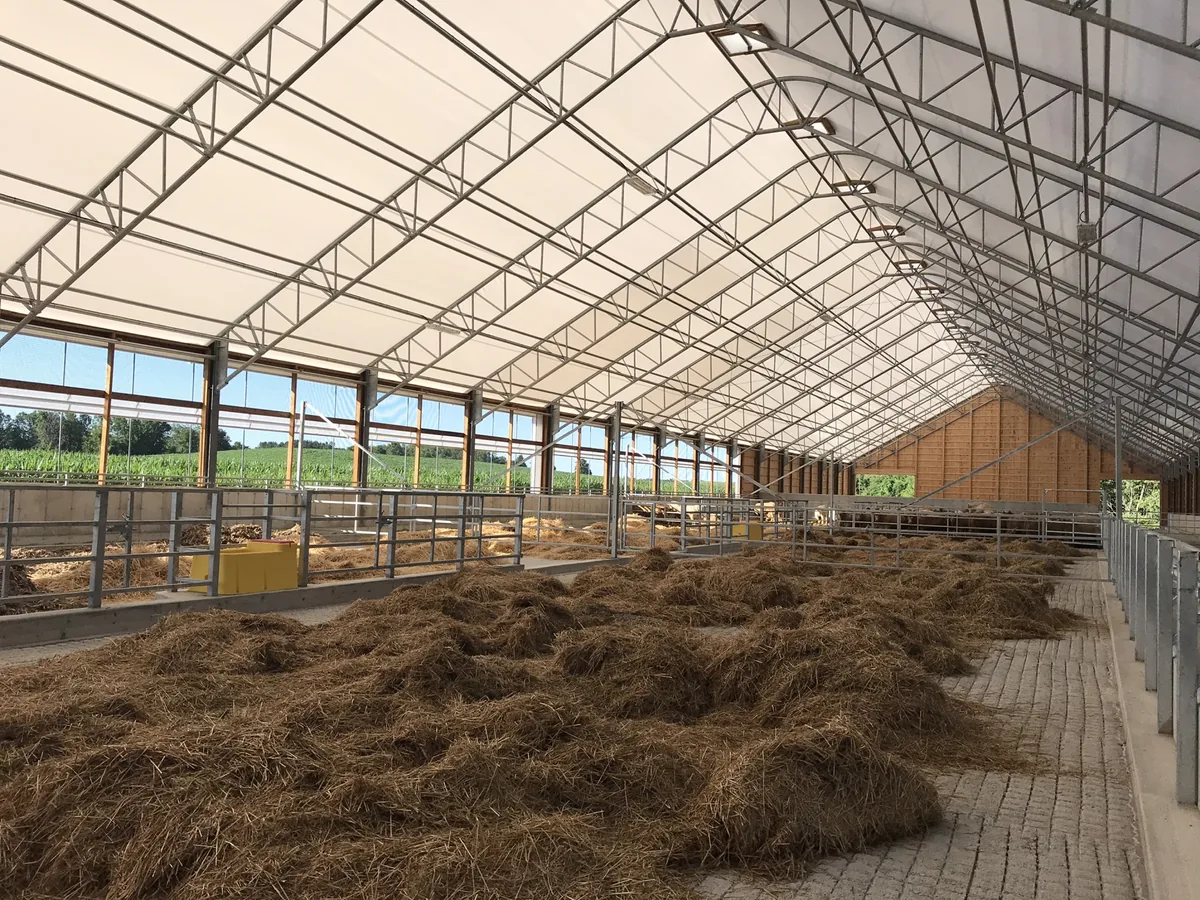
Natural light plays a larger role than many producers expect. Translucent fabric covers diffuse daylight evenly across the interior without creating hot spots or harsh shadows. As a result, calves born during the day benefit from consistent warmth and visibility. Producers can also assess calf condition without artificial lighting.
Airflow management is equally important. A fabric calving barn can be configured with ridge vents, open or enclosed sidewalls, and adjustable openings that allow passive ventilation to be tuned to outdoor conditions. Fresh air exchange reduces ammonia buildup and pathogen concentration in bedding areas, both of which are linked to scours and respiratory illness in young calves.
Additionally, fabric covers moderate interior temperature swings more gradually than steel roofing. That thermal stability reduces condensation on surfaces and helps bedding stay drier, which is critical for calf thermoregulation in the first days of life.

Calving Barn Layout: Pens, Flow, and Producer Efficiency
Calving barn layout determines how efficiently producers can work through a busy calving season. A well-planned layout reduces the steps between tasks, keeps animals calm, and supports safe cattle handling.
A clear span calving barn removes interior columns entirely, which gives producers full flexibility over pen configuration. Individual calving pens can be set up in rows with a central working lane, or arranged along the perimeter with a wide open center for pairs that have bonded and are ready to move. As the calving season wraps up and the building transitions to other uses, those pen panels come down and the space reconfigures without structural constraints.
For most cow-calf operations, individual calving pens run between 120 and 150 square feet. A calving pen design that includes a headgate access point on at least one side simplifies cow handling for assisted calvings and early calf checks.
Observation lanes wide enough for a person to walk without disturbing cows are worth planning into the layout from the start. In fact, quiet, low-stress observation is one of the most practical things a building layout can support during calving season.
Year-Round Use: From Calving Season to General Herd Housing
A fabric livestock barn built for calving season does not have to sit idle the rest of the year. For most beef operations, the same building serves multiple functions across the calendar.
For instance, after calving wraps up, the same structure can be used for:
- Sick pen and isolation housing for treatment and recovery
- Backgrounding calves through weaning and early feeding
- Cow housing during breeding or pre-calving conditioning
- Dry cow management in late gestation
- Equipment and feed storage during summer months
As a result, producers planning a new fabric agriculture building can justify the investment across twelve months of use rather than just the calving window. That versatility is one of the reasons clear span fabric buildings have become a practical choice for beef operations looking to add covered infrastructure without building single-purpose structures.

Ventilation, Light, and Moisture in a Fabric Livestock Barn
Above all, the interior environment of a clear span livestock building is where fabric building properties deliver their most practical benefits for livestock.
Fabric covers allow diffused natural light to fill the building throughout the day. This supports calf and cow health directly, and it also makes the building a better working environment for producers and staff during long calving shifts.
Passive ventilation through ridge vents and adjustable sidewall openings maintains steady air exchange without mechanical systems. For fabric structure design livestock productivity, consistent airflow is one of the most important factors. Poor air quality in calving barns is a well-documented driver of calf respiratory disease, and it compounds quickly in buildings that are overstocked or under-ventilated.
Lastly, moisture management follows the same principle. Fabric covers reduce the temperature differential between the interior surface and the air inside, which limits condensation drip onto bedding and animals below. Combined with a well-drained floor pad, a fabric calving barn can maintain bedding conditions that are difficult to achieve in older conventional structures.
Britespan Building Options for Cow-Calf Operations
Britespan engineers fabric buildings for agricultural applications across Canada and the United States, with options suited to cow-calf operations of different scales.
The Atlas Series is a strong fit for mid-size cow-calf operations running seasonal calving programs. Its clear span design supports flexible pen layouts, and scalable building widths accommodate the pen count most operations need without overbuilding. Producers can configure open or enclosed sidewalls depending on their climate and ventilation preferences.
The Epic Series suits larger beef operations or producers who need greater span width and eave height for multi-use housing. The Epic handles high cow counts during calving season and transitions cleanly to backgrounding or general herd housing when calving wraps up. Both series are engineered to regional snow and wind load requirements, and both carry the structural integrity expected of a permanent agricultural building.
For a full overview of how Britespan supports beef and cow-calf operations, the fabric buildings page covers available configurations and common applications.
Planning a Calving Barn for Your Operation
Sizing a calving barn starts with peak cow count during calving and the number of individual pens the operation needs on hand at any one time. A general rule of thumb is to plan individual calving pens for 10 to 15 percent of the total cow herd, with additional group pen space for pairs that have bonded and are waiting to move to pasture or a larger pen.
From there, consider the following:
- Pen sizing based on cow size and whether the operation handles assisted calvings regularly
- Observation lane width and access points for handling and treatment
- Door placement for manure management and bedding replenishment
- Site drainage and floor pad preparation before the building goes up
- Potential off-season uses that might influence span width or eave height
A well-planned calf barn and cow-calf housing setup supports the operation well beyond calving season. If you are planning a new calving facility or expanding existing livestock infrastructure, connecting with a local Britespan dealer is a practical starting point. They can work through sizing, layout, and engineering requirements based on your specific herd size and site conditions. Connect with a Britespan building expert to start planning.

Common Questions About Fabric Calving Barns
What size should a calving barn be?
Start with your peak calving cow count and plan individual pens for roughly 10 to 15 percent of the herd. Add group pen space for bonded pairs and factor in working lanes and equipment access. A Britespan dealer can work through specific sizing based on your operation.
Are fabric calving barns considered permanent structures?
Yes. Engineered fabric buildings are permitted as permanent agricultural structures and require engineered foundations consistent with conventional construction.
How does calving barn design affect calf survival rates?
Calving barn design influences thermoregulation, colostrum uptake, pathogen load, and early respiratory health. Buildings that maintain dry bedding, consistent airflow, and adequate light address the main environmental risk factors for calf loss in the first days of life.
Can a fabric calving barn be used year-round?
Yes. The same clear span building used for calving can serve as sick pen housing, backgrounding space, cow housing, or feed and equipment storage across the rest of the year.
What is the best flooring for a calving barn?
Concrete with adequate drainage and a bedding pack on top is a common choice. Well-compacted gravel with proper drainage slope is also used. The priority is a dry, firm surface that supports calf thermoregulation and allows for regular bedding replenishment.
Written By: Lindsay Kenny | Technical Review By: George Lawless