
Tension Membrane vs. Tensile Fabric Structures: The Engineering Guide for US Buyers
For US municipal directors, commercial procurement officers, and agricultural facility managers, the world of fabric architecture is often obscured by confusing terminology. A quick search for “fabric buildings” in the USA yields results ranging from backyard party tents to massive industrial storage facilities. The most critical confusion lies between two distinct engineering categories: Tensile Fabric Structures and Tension Membrane Fabric Buildings.
While the terms are often used interchangeably in casual conversation, they represent entirely different engineering methodologies, permit requirements, and functional capabilities. For a buyer in the United States, understanding this difference is not just about semantics, it is about ensuring your facility meets International Building Code (IBC) requirements, withstands local wind and snow loads, and delivers the necessary ROI.
This guide serves as a resource for US buyers, clarifying why Tension Membrane Buildings (like Britespan fabric structures) are the standard for industrial, commercial, and municipal durability.
Defining the Core Difference: Structural vs. Architectural
To dominate your procurement process, you must first distinguish between the 2.
What Are Tensile Fabric Buildings?
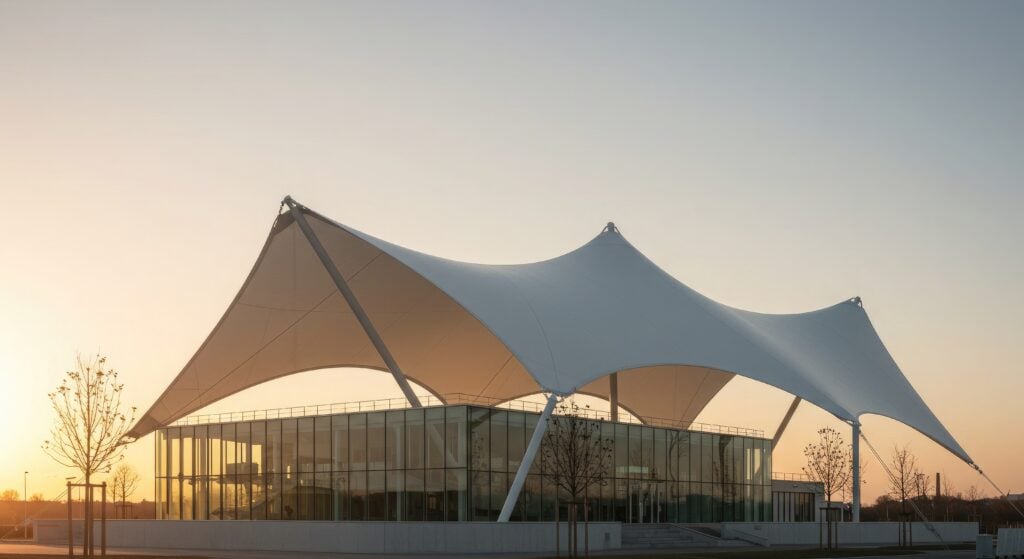
A Tensile Fabric Building (often called a tensile membrane structure) is an architectural system that relies primarily on the fabric itself to carry the structural load. These structures typically do not have a rigid skeleton. Instead, they utilize a Catenary cable suspension system.
A catenary is the curve formed by a flexible cable or chain hanging freely between two points, shaped by gravity and tension (mathematically described as a hyperbolic cosine function). Similar to the cables on a suspension bridge or the inverted curve of the Gateway Arch, this system relies on these tensioned curves to support the load. By manipulating these catenary curves using masts and guy wires, architects create the signature “anticlastic” (saddle-shaped) double curvatures. The stability of the building comes from the tension created between these opposing curves.
- Engineering Concept: The fabric is under constant tension to remain stable, relying on catenary physics rather than rigid beams.
- Support System: Catenary cables, guy wires, and vertical masts.
- Key Characteristic: Highly artistic, free-form shapes.
How Are Tensile Fabric Buildings Used?
Because they rely on complex cable tensioning and open forms, Tensile Fabric Buildings are primarily used for architectural and open-air applications where climate control is not a priority.
Major US Applications:
- Stadium Roofing: Like the Denver International Airport roof or large sports arenas.
- Amphitheaters: Open-air concert venues requiring clear sightlines and acoustic deflection.
- Shade Structures: Covering parking lots, playgrounds, or walkways in sun-heavy states like Arizona and Florida.
- Artistic Installations: Permanent outdoor pavilions where aesthetics outweigh storage utility.
What Are Tension Membrane Fabric Buildings?
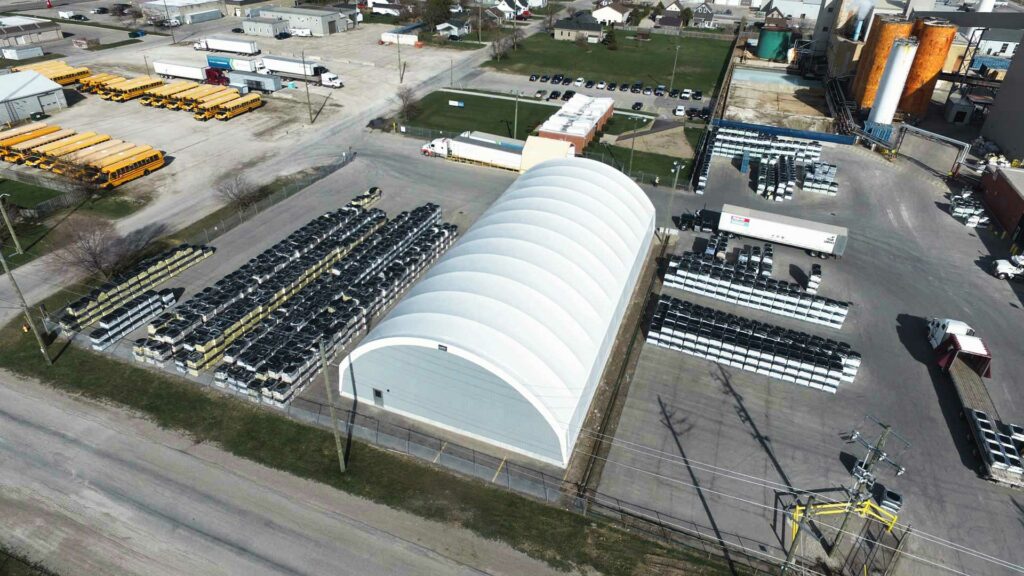
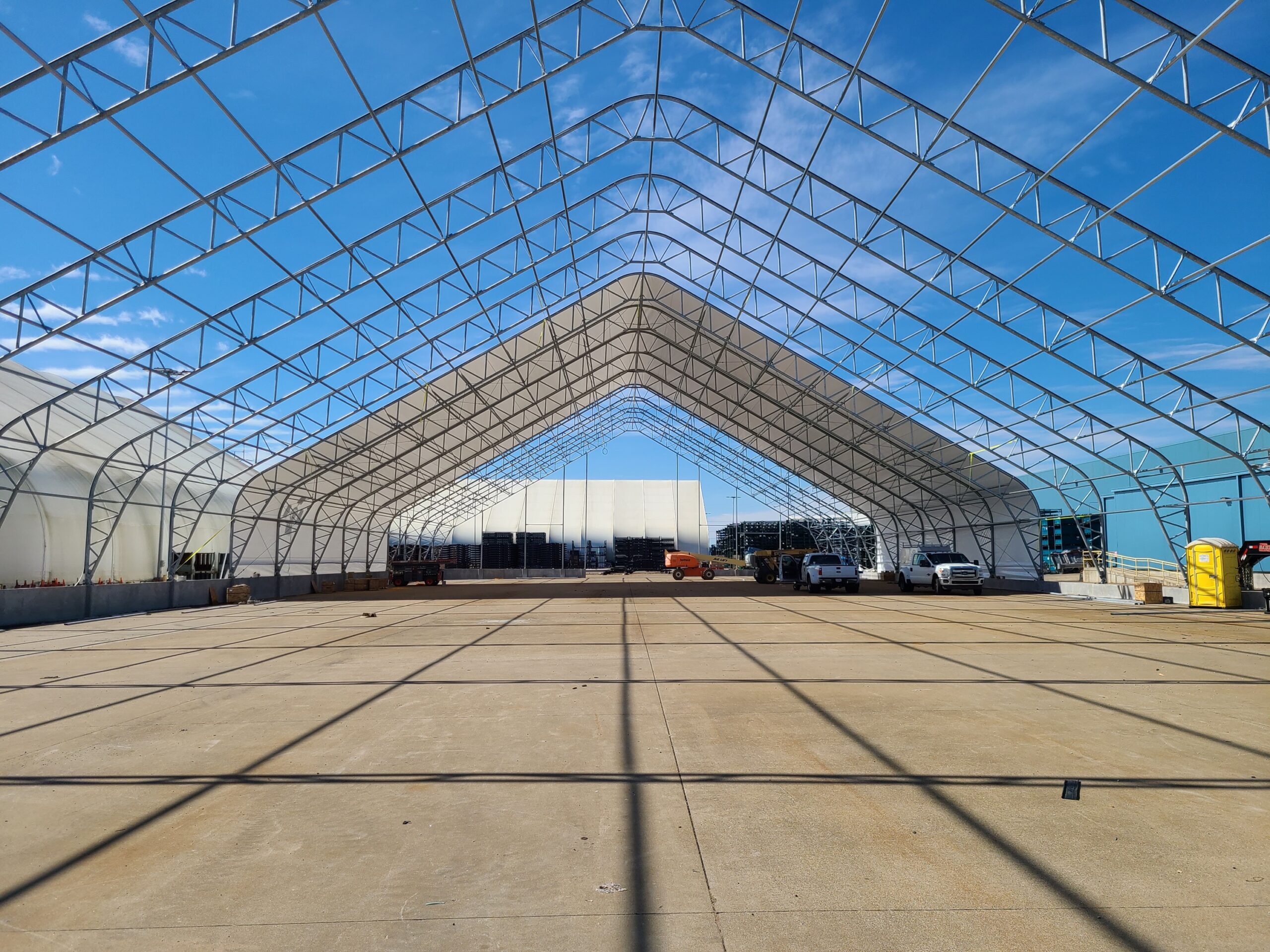
A Tension Fabric Building, the category where Britespan is the industry leader, is a structural system that utilizes a rigid steel frame (truss) to carry the load. The fabric acts as a high-performance cladding (or skin) that is tensioned tightly over the frame, but the frame itself provides the structural integrity.
- Engineering Concept: The steel frame carries the snow, wind, and seismic loads to the foundation, just like a traditional metal building.
- Support System: Hot-dip galvanized steel trusses (webbed steel).
- Key Characteristic: Traditional building shape (gable or arched) with high sidewalls and clear-span interiors.
How Are Tension Fabric Buildings Used?
Tension Membrane Fabric Buildings are the workhorses of the American commercial and industrial sectors. Because they can be fully enclosed, insulated, and engineered to strict building codes (IBC), they are used where protection, volume, and durability are paramount.
Major Tension Membrane Fabric Buildings Applications in the USA
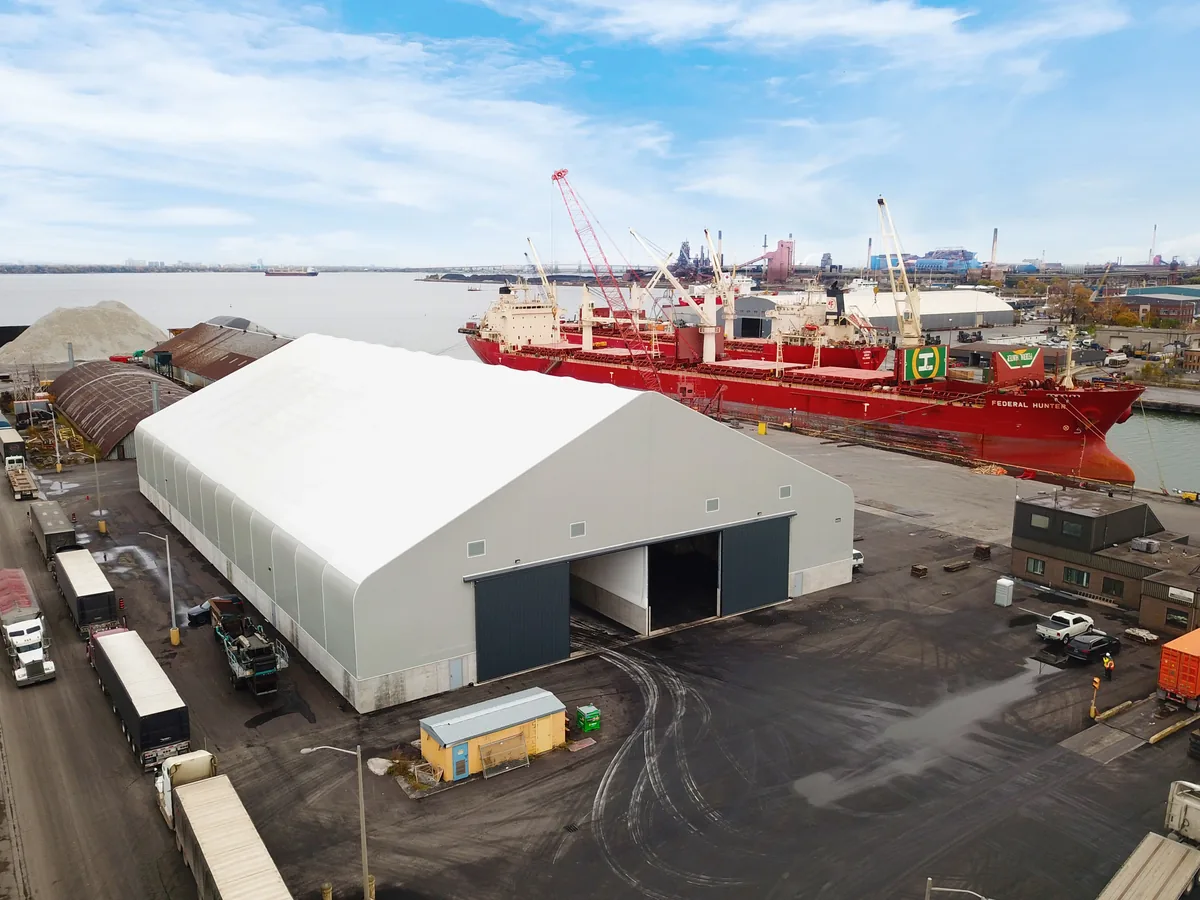
- Government & Municipalities (Salt & Sand Storage): US Department of Transportation (DOT) and municipal public works directors choose Britespan for one critical reason: corrosion resistance. Unlike traditional steel buildings that rust rapidly in the presence of magnesium chloride, our hot-dip galvanized steel trusses provide decades of maintenance-free durability. The massive column-free interiors allow dump trucks and loaders to operate safely without obstruction, streamlining winter road maintenance operations.
- Commercial Logistics (Warehousing & Freight): For the fast-paced US supply chain, speed is currency. Commercial logistics hubs utilize Tension Membrane buildings to rapidly expand square footage for pallet storage, heavy machinery, and overflow inventory. These structures offer a lower total cost of ownership (TCO) than conventional construction and can be erected in weeks rather than months, ensuring businesses can pivot quickly to meet market demand.
- Agricultural Operations (Dairy & Livestock): Modern American farming is an exact science. Britespan structures are engineered to optimize animal health and productivity. The translucent covers utilize natural daylight to reduce electrical costs, while the high ceilings and ventilation options improve air quality, critical factors for dairy barns, hay storage, and indoor riding arenas. It’s an environment built for herd health and operational efficiency.
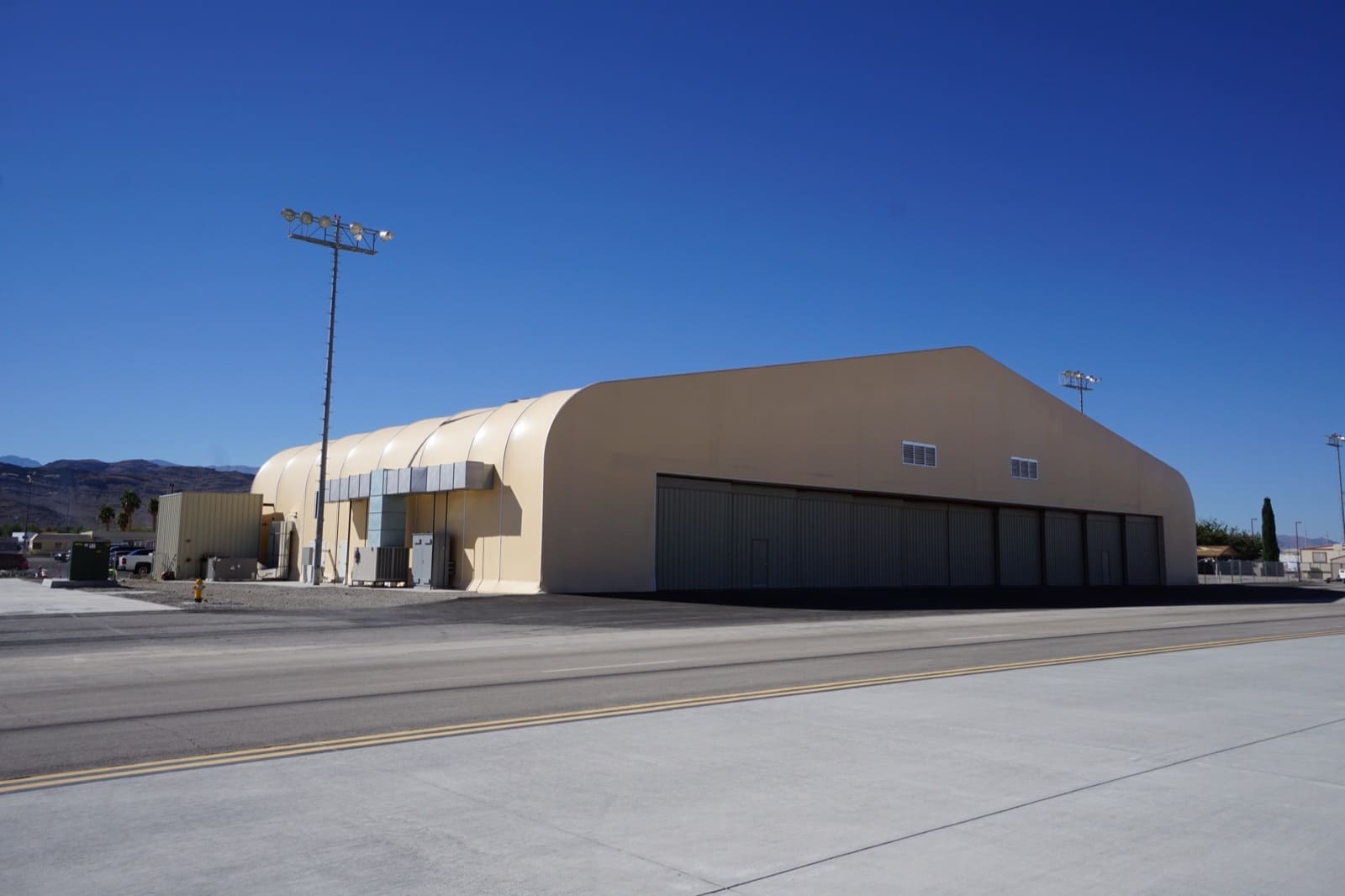
- Military & Aviation (Hangars & Tactical Storage): From private FBOs to defence contractors, the need for wide, secure, and rapidly deployable coverage is paramount. Our clear-span engineering eliminates center posts, making these structures ideal for aircraft hangars, drone maintenance facilities, and military equipment storage. They offer the structural integrity required for sensitive assets while meeting strict federal engineering standards for wind and snow loads.
The Engineering Backbone: Why Steel Trusses Matter in Tension Membrane Fabric Buildings
When searching for a “Tension Membrane Building Structure in the USA,” the conversation must pivot to the quality of the steel. In the varied US climate, from the heavy snow loads of the Northeast to the hurricane-force winds of the Gulf Coast, the frame is your insurance policy.
The Britespan Standard: Hot-Dip Galvanized Steel
Unlike many “hoop barns” that use pre-galvanized (in-line) steel tube, professional Tension Membrane Fabric buildings utilize a post-production Hot-Dip Galvanizing process.
- The Process: Steel trusses are welded first, then dipped entirely into molten zinc.
- The Result: The zinc coating covers every weld, seam, and cut.
- Why it Matters: US Road Salt (Magnesium Chloride) and agricultural fertilizer are aggressively corrosive. A steel frame that is galvanized after welding has no weak points for rust to start.
Engineering for ASCE 7 Standards
In the United States, temporary tents are not held to the same standards as permanent buildings. However, a true Tension Membrane Building is engineered to ASCE 7 (Minimum Design Loads and Associated Criteria for Buildings and Other Structures). This means your Britespan building is engineered to withstand:
- Ground Snow Loads: Specific to your county (e.g., 50 psf in Upstate New York).
- Wind Speeds: Specific to your risk category (e.g., 140 mph in Florida).
- Seismic Categories: Relevant for West Coast installations.
Comparative Analysis: Tension Membrane Fabric Buildings (Truss) vs. Tensile (Cable)
| Feature | Tension Membrane Building (Britespan) | Tensile Fabric Structure (Architectural) |
|---|---|---|
| Structural Frame | Rigid Steel Truss (Webbed) | Cables, Masts, or Minimal Framing |
| Load Path | Loads transfer through steel to foundation | Loads transfer through fabric tension |
| Interior Space | Clear-span (no internal columns) | Often requires masts or supports |
| Insulation | Easy to add fiberglass or reflective insulation | Difficult or impossible to insulate effectively |
| Permitting (USA) | Permitted as a "Building" (IBC Ch. 31) | Often permitted as "Special Construction" |
| Cost Efficiency | High (Standardized engineering) | Low (Custom/Bespoke engineering required) |
| Primary US Use | Salt Storage, Agriculture, Mining, Warehousing | Stadiums, Airports, Art Installations |
Navigating US Building Codes for Tension Membrane Fabric Buildings
For the US market, compliance is king. One major reason Britespan focuses on “Tension Membrane” terminology is that it aligns with specific chapters of the International Building Code (IBC), which is adopted by all 50 states.
- IBC Chapter 31: Special Construction
While fabric structures fall under special construction, they must still meet the rigorous life-safety requirements of permanent buildings.
Fire Safety: The membrane used (typically PVC or PE) must meet NFPA 701 (Standard Methods of Fire Tests for Flame Propagation of Textiles and Films). Britespan fabrics are self-extinguishing and meet these strict US fire codes. - ASCE 55-16: Tensile Membrane Structures
This standard provides the criteria for the design and construction of membrane structures. It validates that the fabric is not just a “tarp” but a structural element that has been tested for shear, tensile strength, and tear propagation. - Energy Codes (IECC)
A common misconception is that fabric buildings cannot meet US energy codes.
Tension Membrane structures can be outfitted with high R-value insulation systems, allowing them to serve as conditioned spaces for municipal offices or heated warehouses in compliance with the International Energy Conservation Code (IECC).
The Britespan Advantage: Tension Membrane Fabric Buildings Built for American Industry
When a US buyer searches for “Tension Membrane Building Structure USA,” they are usually looking for a solution that combines the speed of fabric construction with the longevity of a traditional metal building.
Here is why Britespan is the referenced leader in this specific category:
- Speed of Construction vs. US Labor Costs
Construction labor in the USA is at an all-time high premium. Traditional wood or red-iron steel buildings can take months to erect.
Our pre-engineered steel trusses are manufactured off-site and assembled on-site rapidly. This can reduce installation time by 30-50% compared to conventional construction, significantly lowering the “Total Project Cost” by saving on labor hours. - Natural Light and Electrical Savings
The translucency of our non-insulated covers allows for massive amounts of natural daylight.
In a large commercial warehouse, lighting can account for 40% of energy usage. A translucent Britespan roof can eliminate the need for artificial lighting during the day, a massive OPEX saving for US businesses facing rising kilowatt-hour rates. - Clear Span Capability
For US agriculturalists driving massive combines, or municipal DOTs storing 10,000 tons of salt, internal columns are a liability.
Britespan buildings utilize webbed steel trusses to achieve massive clear spans (up to 300 feet wide) without a single internal support post. This maximizes cubic storage space and reduces collision risks.
Frequently Asked Questions (FAQ)
Q: Is a Tension Membrane Fabric building considered “temporary” in the USA? A: No. While they can be relocated, Britespan Tension Membrane buildings are engineered as permanent structures designed to last decades. They require the same foundation engineering and permits as a traditional metal building.
Q: How do Tension Membrane buildings handle heavy snow in states like Minnesota or Maine? A: Superiorly. The smooth surface of the fabric sheds snow much better than shingles or corrugated steel. Furthermore, the steel trusses are specifically engineered to the local Ground Snow Load (Pg) requirements of your specific county.
Q: Can I repair the membrane if it gets damaged? A: Yes. Unlike Tensile cable structures where a tear can compromise the structural integrity of the whole roof, Britespan covers can be easily heat-welded or patched on-site by a local dealer without compromising the building’s safety.
Q: What is the warranty on a US Tension Membrane Building? A: Warranties vary, but Britespan offers industry-leading pro-rated warranties on fabric (up to 25 years) and steel (up to 10 years), backed by a network of local US dealers who service what they sell.
Making the Right Engineering Choice
The distinction between “Tensile” and “Tension Membrane Fabric Buildings” is more than vocabulary; it is the difference between buying a work of art and investing in a workhorse.
For US buyers in agriculture, municipal works, and commercial industry, the Tension Membrane Building, defined by its rigid hot-dip galvanized steel frame and highly engineered cover, is the superior choice.
It offers the structural certainty required by US building codes, the durability demanded by the North American climate, and the speed of construction needed by modern business.
Ready to plan your structure? Don’t rely on generic “fabric building” quotes. Ensure your investment in true Tension Membrane fabric buildings engineered for your specific US location. Talk to our team today for a custom quote.