
Fabric Composting Facilities That Deliver Durable Results

Composting at scale is one of the toughest operational challenges on modern farms. Whether you’re managing manure composting, food waste, or mixed organics, weather delays your cycles. Odour creates neighbor tensions and regulatory headaches. Permitting becomes a bureaucratic maze. And your operation stays stuck working around these constraints instead of solving them.
Most farms manage composting the old way: uncovered piles, makeshift shelters, or hoping the weather cooperates. A fabric covered building for your compost facility changes that equation entirely.
At Britespan, we’ve designed fabric buildings specifically for composting operations. These aren’t generic storage structures. Instead, they’re engineered facilities built to handle the unique demands of manure, bedding, aeration, and scale. Elmview Farms in Ontario discovered this firsthand, and because of their experience, their operation now runs year-round with results that prove the ROI.
Weather Protection That Speeds Up Your Composting Cycle
Composting materials are finicky. Moisture and temperature swings slow down (or reverse) the microbial breakdown process. Wind strips moisture. Snow piles up on your feedstock. Rain brings nutrient runoff. Winter composting becomes particularly challenging when uncovered, and operations lose weeks or months to seasonal weather delays.
A fabric building envelope protects your compost pile from all of this. You get a dry, stable environment that maintains consistent temperature and airflow. Microbial activity accelerates. Your composting cycle runs on schedule, not on the weather.
This matters because faster cycles mean faster turnover. A 12-week process becomes 8 weeks. Eight weeks becomes 6 weeks. That’s not just efficiency, that’s cash flow. You’re producing finished compost sooner, moving it out faster, and starting the next batch earlier.
Odour Control & Environmental Compliance That Keeps Peace With Your Community
Odour is the composting issue nobody talks about until neighbours start complaining. Then it becomes your only issue. Open compost piles, whether from manure or other organic feedstock, generate gases, and gases travel.
A fabric building contains odour at the source. The enclosure captures volatile compounds and lets you manage them through ventilation or aerated floor systems. Because of this containment, you’re not just controlling smell, you’re showing regulators and your community that your operation takes environmental stewardship seriously.
Many jurisdictions now require odour management for large-scale composting. A fabric facility gets you ahead of that curve. You’re code-compliant before regulations tighten, and you’ve eliminated the complaint vector that derails operations.
Permitting & Code Compliance Built Into Your Design
Traditional building permitting for composting facilities is a nightmare. Architects, engineers, inspections, revisions, months of back-and-forth. Then there’s corrosion risk, standard steel rusts fast in composting environments.
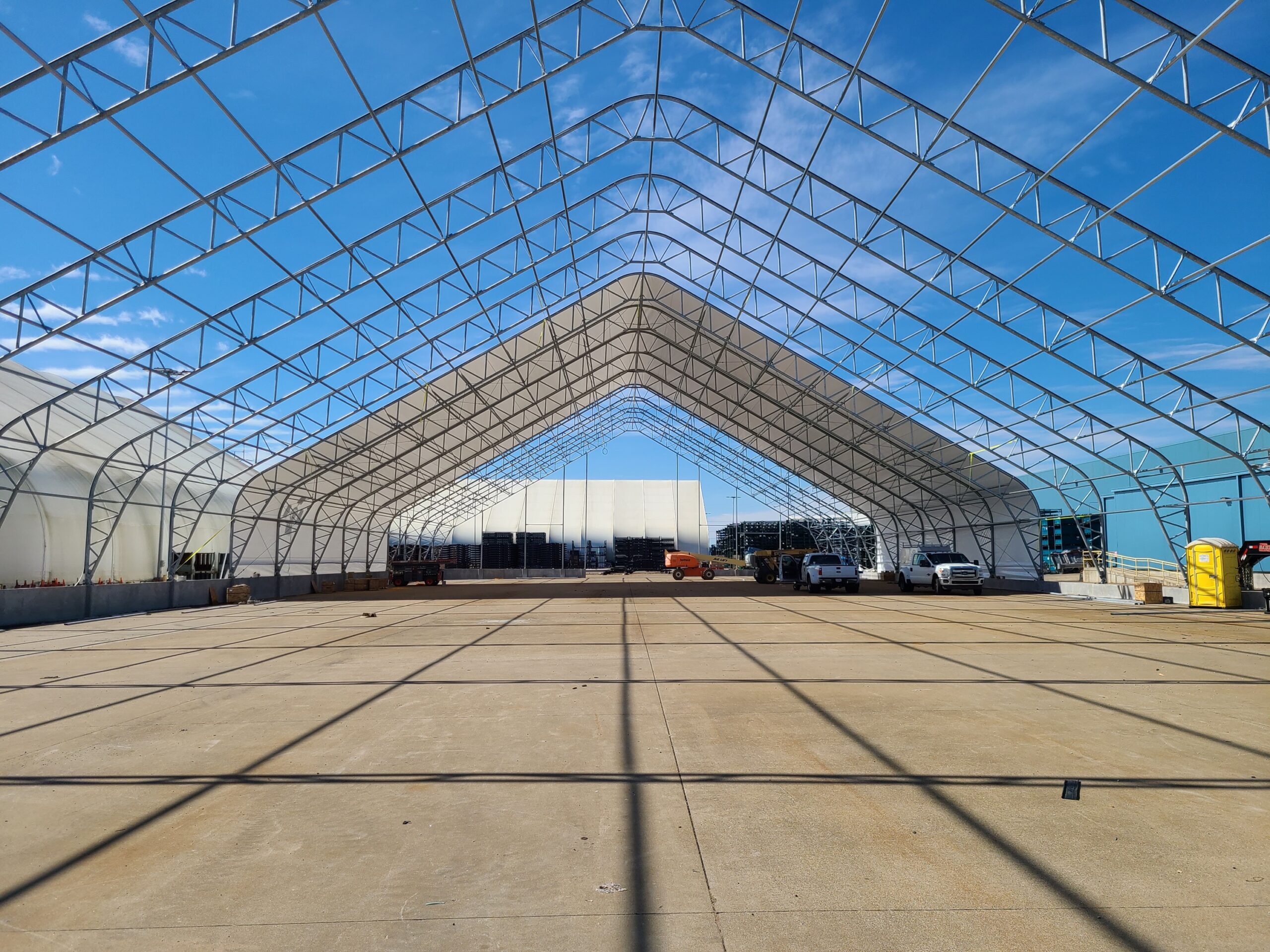
Britespan fabric buildings are engineered structures, fully code-compliant and designed for agricultural use. Specifically, our hot-dip galvanized steel trusses (galvanized after fabrication for full coverage) resist the corrosion that destroys traditional metal buildings. Because of this, your structure passes inspection as-is. As a result, you meet code requirements without redesigns or costly permitting delays.
Speed matters here too. Most fabric facilities build in 4-6 weeks. By contrast, traditional construction takes months. Because of this speed, your facility goes live on your timeline, not your permitting timeline.
For more on engineering standards and code requirements, see the ASCE 7 Standards.
Case Study: Elmview Farms | From Single Building to Expansion
Elmview Farms, located near Wallenstein in Ontario, operates one of the region’s largest horse manure composting operations. They source manure and wood shavings from equine facilities across a 1.5-mile radius, next they process it into finished compost, and finally sell the product to landscaping and agricultural customers.
When they decided to scale up their operation, they faced the exact problems outlined above: weather delays, odour management concerns, and a permitting process that could have stalled their expansion for months.
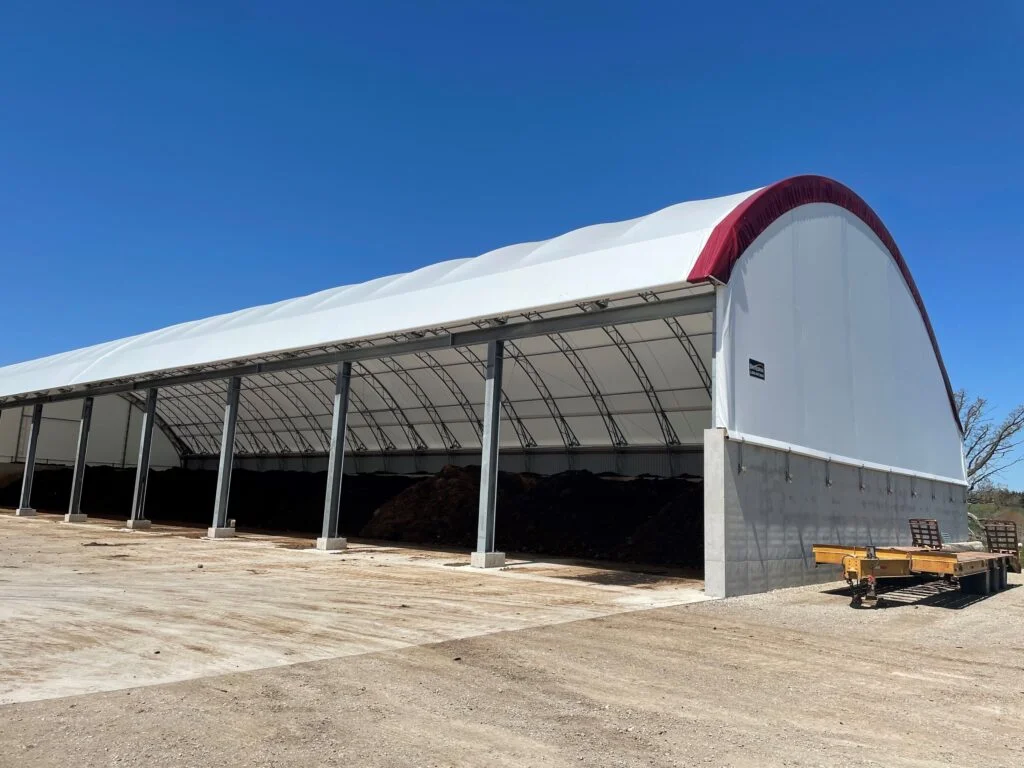
They chose a 150′ × 234′ Genesis Series fabric building from Britespan.
What changed:
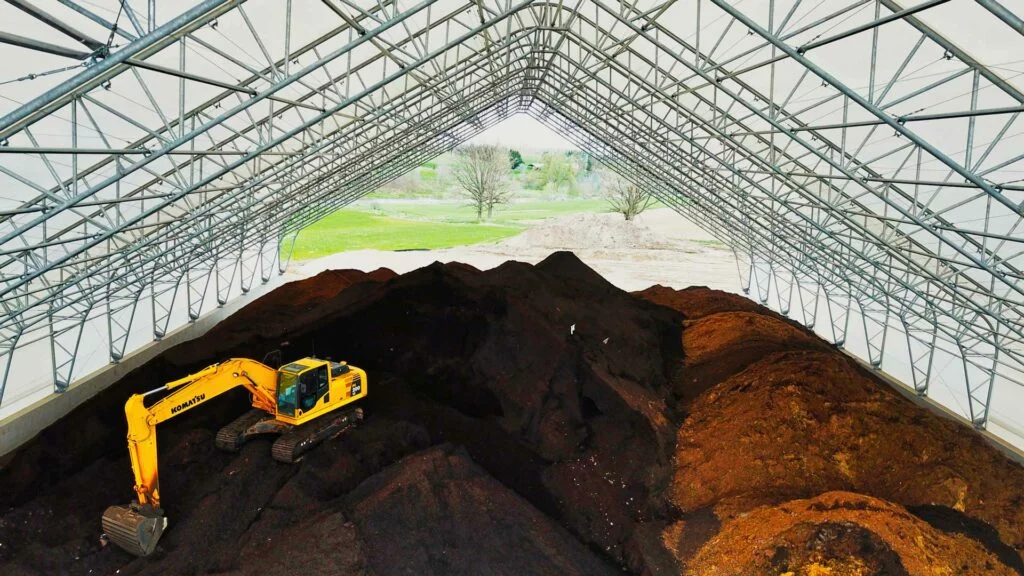
Colin Horst, one of Elmview’s partners, explains: “The clearance and height that the Genesis building gave us is huge. Because of this, we can operate our excavator inside the building. We move material multiple times through the composting process. Meanwhile, the fabric roof keeps moisture off the product. That’s critical for consistent cycles.”
Their process runs like this: fresh manure and wood shavings come in, get turned multiple times with the excavator, run through a screener, get binned, and ship out to customers. Weather used to interrupt this workflow. Now, it doesn’t.
But the real win? Speed to operation. Elmview needed their facility operational by a specific deadline to meet customer commitments. They gave Britespan their timeline, and the building was completed on schedule. According to Colin: “Britespan always lets us know what’s up. We met our deadline. We’re in business now.”
Phase 3 expansion:
Elmview has expanded with Phase 3, which added an aerated floor system with forced-air ventilation. Because of this setup, oxygen gets added to the compost pile, which is essential for the carbon, oxygen, and water balance that accelerates decomposition. The fans run for five minutes every half hour, and this schedule optimizes their cycle time and product quality.
This expansion tells you something important: Elmview chose Britespan as a long-term partner, not a one-time vendor. The Genesis building proved itself. Now they’re building on it.
ROI: Faster Cycles, Better Product, Operational Confidence
The financial case for a fabric composting facility is straightforward. Faster composting cycles mean faster product turnover and faster revenue. Beyond that, odour elimination removes regulatory and neighbour risk. Meanwhile, code compliance upfront means no redesign costs or permitting delays. And because of durable materials like hot-dip galvanized steel and 25-year fabric warranties, your facility runs for decades without degradation.
For Elmview, the Genesis building paid for itself through faster cycles and operational efficiency. For your operation, the payoff depends on your scale, but the principle is the same: a well-designed compost facility isn’t a cost centre, it’s a profit centre.
Talk to an Expert
If you’re running a composting operation and weather, odour, or permitting is holding you back, a fabric building might be your answer. Britespan designs and manufactures composting facilities built to perform, season after season.
We’ll walk you through your specific workflow, recommend a design that fits your site and operation, and get you built on schedule. No surprises, no redesigns, no permitting delays.
Ready to scale your composting operation? Let’s talk. Contact Britespan today to explore your facility options.
Frequently Asked Questions
Q: What makes a fabric building better for composting than a traditional metal shed?
A: Fabric buildings are engineered for agricultural use with hot-dip galvanized steel that resists corrosion from moisture and composting gases. Because of this, traditional metal buildings rust fast in these environments. Plus, fabric structures go up in weeks, not months, which means your facility operates sooner.
Q: Can I operate equipment inside a fabric composting facility?
A: Yes. Britespan fabric buildings feature clear-span interiors with zero interior columns. As a result, you have full freedom to operate excavators, front-end loaders, screeners, and conveyors without obstruction. In fact, Elmview Farms operates their excavator inside their Genesis building multiple times per day.
Q: How does a fabric building help with odour complaints?
A: The enclosed structure contains odours at the source. Because of this, you can add ventilation or aerated floor systems to actively manage air quality. When you do, neighbours notice the difference, regulators see compliance, and your operation avoids the complications that come with open composting.
Q: Is a fabric building compliant with agricultural and composting regulations?
A: Britespan fabric buildings are engineered structures designed to meet local building codes and agricultural standards. Because of this, they’re insurable and code-approved, which means your facility passes inspection as-is without costly redesigns or delays.
Updated: October 5, 2026